

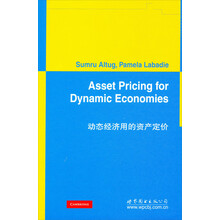
动态经济用的资产定价
目 录内容简介
The starting point for any analysis in finance involves assigning a cur-rent price tO a future strearfi of uncertain payoffs.This iS the basic notionbehind any asset.pricing model.Take for example,the price of a sharetO a competitive firm.Since the share entitles the owner to claims for the future profits of the firm.a central problem iS tO assign a value to thesefuture profits.Take another asset-a house.This provides housing ser-vices in all states of nature and at all dates.Consequently,the value of thehouse today must reflect the value of these future services。Other examplesinclude the pricing of durable goods or investment projects based on theirfuture expected marginal products.One approach tO monetary economicsalso follows this basic principle-if money as an asset has value in equilib,rium(in the absence of any legal restrictions),then this value must reflectthe stream of services provided by this asset.
Our approach is tO derive pricing relationships for different assets byspecilying the economic environment at the outset.OHe of the earliestexamples of this approach is Merton〔342〕.However,Merton does notrelate the technological sources of uncertainty tO the equilibrium prices ofthe riskv assets.AIternatively,he assumes a given stochastic process for thereturns of different types of assets and then prices them given assumptionsabout consumer preferences.Consequently,the supply side is not explic.itly considered by Merton.The asset-pricing model of Lucas〔317〕is fullygeneral equilibrium but it iS an endowment economy,SO that consumptionand investment decisions are trivial.Brock〔76〕develops an asset.pricingmodel with both the demand and supply side fully specified and links itup tO Ross‘s〔369〕arbitrage pricing model.
In this book,we will start from an explicit economic environment anddeduce the implications for asset prices,and the form of the asset-pricingfulnction from the equilibrium in these environments.To study the prob-lem of asset pricing,we COUId also follow another approach:we couldtake a very general and abstract approach,Vmwlng asset pricing as thevaluation of a future stream of uncertain payoffs from the asset accord.mg tO a general pricing function.(Aiven a minimal set ot assumpnonsabout the set of payoffs,we could try tO characterize the properties ofthis abstract pricing function.
Our approach is tO derive pricing relationships for different assets byspecilying the economic environment at the outset.OHe of the earliestexamples of this approach is Merton〔342〕.However,Merton does notrelate the technological sources of uncertainty tO the equilibrium prices ofthe riskv assets.AIternatively,he assumes a given stochastic process for thereturns of different types of assets and then prices them given assumptionsabout consumer preferences.Consequently,the supply side is not explic.itly considered by Merton.The asset-pricing model of Lucas〔317〕is fullygeneral equilibrium but it iS an endowment economy,SO that consumptionand investment decisions are trivial.Brock〔76〕develops an asset.pricingmodel with both the demand and supply side fully specified and links itup tO Ross‘s〔369〕arbitrage pricing model.
In this book,we will start from an explicit economic environment anddeduce the implications for asset prices,and the form of the asset-pricingfulnction from the equilibrium in these environments.To study the prob-lem of asset pricing,we COUId also follow another approach:we couldtake a very general and abstract approach,Vmwlng asset pricing as thevaluation of a future stream of uncertain payoffs from the asset accord.mg tO a general pricing function.(Aiven a minimal set ot assumpnonsabout the set of payoffs,we could try tO characterize the properties ofthis abstract pricing function.
比价列表价格走势


公众号、微信群
 缺书网
缺书网微信公众号
 扫码进群
扫码进群实时获取购书优惠