

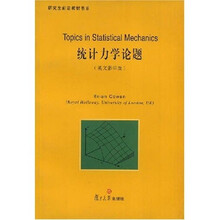
研究生前沿教材书系:统计力学论题(英文影印版)
The Methodology of Statistical Mechanics
1.1Terminology and Methodology
1.1.1Approaches to the subject
1.1.2 Description of states
1.1.3Extensivity and the thermodynamic limit
1.2The Fundamental Principles
1.2.1The laws of thermodynamics
1.2.2Probabilistic interpretation of the First Law
1.2.3Microscopic basis for entropy
1.3Interactions -- The Conditions for Equilibrium
1.3.1Thermal interaction -- Temperature
1.3.2Volume changePressure
1.3.3Particle interchange -- Chemical potential
1.3.4Thermal interaction with the rest of the
world -- The Boltzmann factor
1.3.5Particle and energy exchange with the rest
of the world -- The Gibbs factor
1.4Thermodynamic Averages
1.4.1The partition function
1.4.2 Generalised expression for entropy
1.4.3Free energy
1.4.4 Thermodynamic variables
1.4.5Fluctuations
1.4.6 The grand partition function
1.4.7 The grand potential
1.4.8 Thermodynamic variables
1.5Quantum Distributions
1.5.1Bosons and fermions
1.5.2Grand potential for identical particles
1.5.3 The Fermi distribution
1.5.4The Bose distribution
1.5.5The classical limit -- The Maxwell distribution
1.6Classical Statistical Mechanics
1.6.1Phase space and classical states
1.6.2Boltzmann and Gibbs phase spaces
1.6.3The Fundamental Postulate in the classical case
1.6.4 The classical partition function35
1.6.5The equipartition theorem
1.6.6Consequences of equipartition
1.6.7Liouvilles theorem
1.6.8Boltzmanns H theorem
1.7The Third Law of Thermodynamics
1.7.1History of the Third Law
1.7.2 Entropy
1.7.3Quantum viewpoint
1.7.4Unattainability of absolute zero
1.7.5Heat capacity at low temperatures
1.7.6Other consequences of the Third Law
1.7.7Pessimists statement of the laws of
thermodynamics
Practical Calculations with Ideal Systems
2.1The Density of States
2.1.1Non-interacting systems
2.1.2Converting sums to integrals
2.1.3Enumeration of states
2.1.4Counting states
2.1.5General expression for the density of states
2.1.6General relation between pressure and energy
2.2Identical Particles
2.2.1Indistinguishability
2.2.2Classical approximation
2.3Ideal Classical Gas
2.3.1Quantum approach
2.3.2 Classical approach
2.3.3 Thermodynamic properties
2.3.4 The 1/N! term in the partition function
2.3.5 Entropy of mixing
2.4Ideal Fermi Gas
2.4.0Methodology for quantum gases
2.4.1Fermi gas at zero temperature
2.4.2 Fermi gas at low temperatures-- simple model
2.4.3Fermi gas at low temperatures-- series expansion
Chemical potential
Internal energy
Thermal capacity
2.4.4More general treatment of low temperature
heat capacity
2.4.5High temperature behaviour -- the classical limit.
2.5Ideal Bose Gas
2.5.1General procedure for treating the Bose gas
2.5.2Number of particles -- chemical potential
2.5.3Low temperature behaviour of Bose gas
2.5.4Thermal capacity of Bose gas -- below Tc
2.5.5Comparison with superfluid 4He and
other systems
2.5.6 Two-fluid model of superfluid 4He
2.5.7Elementary excitations
2.6Black Body Radiation -- The Photon Gas
2.6.1Photons as quantised electromagnetic waves
2.6.2Photons in thermal equilibrium -- black
body radiation
2.6.3Plancks formula
2.6.4 Internal energy and heat capacity
2.6.5 Black body radiation in one dimension
2.7Ideal Paramagnet
2.7.1Partition function and free energy
2.7.2 Thermodynamic properties
2.7.3Negative temperatures
2.7.4 Thermodynamics of negative temperatures
3Non-Ideal Gases
3.1Statistical Mechanics
3.1.1The partition function
3.1.2 Cluster expansion
3.1.3Low density approximation
3.1.4 Equation of state
3.2The Virial Expansion
3.2.1Virial coefficients
3.2.2Hard core potential
3.2.3Square-well potential
3.2.4Lennard-Jones potential
3.2.5Second virial coefficient for Bose and Fermi gas
3.3Thermodynamics
3.3.1 Throttling
3.3.2Joule-Thomson coefficient
3.3.3Connection with the second virial coefficient
3.3.4Inversion temperature
3.4Van der Waals Equation of State
3.4.1Approximating the partition function
3.4.2Van der Waals equation
3.4.3Microscopic "derivation" of parameters
3.4.4Virial expansion
3.5Other Phenomenological Equations of State
3.5.1The Dieterici equation
3.5.2Virial expansion
3.5.3 The Berthelot equation
4Phase Transitions
4.1Phenomenology
4.1.1Basic ideas
4.1.2Phase diagrams
4.1.3 Symmetry
4.1.4Order of phase transitions
4.1.5The order parameter
4.1.6Conserved and non-conserved order parameters
4.1.7 Critical exponents
4.1.8 Scaling theory
4.1.9Scaling of the free energy
5Fluctuations and Dynamics
Appendixes
index
1.1Terminology and Methodology
1.1.1Approaches to the subject
1.1.2 Description of states
1.1.3Extensivity and the thermodynamic limit
1.2The Fundamental Principles
1.2.1The laws of thermodynamics
1.2.2Probabilistic interpretation of the First Law
1.2.3Microscopic basis for entropy
1.3Interactions -- The Conditions for Equilibrium
1.3.1Thermal interaction -- Temperature
1.3.2Volume changePressure
1.3.3Particle interchange -- Chemical potential
1.3.4Thermal interaction with the rest of the
world -- The Boltzmann factor
1.3.5Particle and energy exchange with the rest
of the world -- The Gibbs factor
1.4Thermodynamic Averages
1.4.1The partition function
1.4.2 Generalised expression for entropy
1.4.3Free energy
1.4.4 Thermodynamic variables
1.4.5Fluctuations
1.4.6 The grand partition function
1.4.7 The grand potential
1.4.8 Thermodynamic variables
1.5Quantum Distributions
1.5.1Bosons and fermions
1.5.2Grand potential for identical particles
1.5.3 The Fermi distribution
1.5.4The Bose distribution
1.5.5The classical limit -- The Maxwell distribution
1.6Classical Statistical Mechanics
1.6.1Phase space and classical states
1.6.2Boltzmann and Gibbs phase spaces
1.6.3The Fundamental Postulate in the classical case
1.6.4 The classical partition function35
1.6.5The equipartition theorem
1.6.6Consequences of equipartition
1.6.7Liouvilles theorem
1.6.8Boltzmanns H theorem
1.7The Third Law of Thermodynamics
1.7.1History of the Third Law
1.7.2 Entropy
1.7.3Quantum viewpoint
1.7.4Unattainability of absolute zero
1.7.5Heat capacity at low temperatures
1.7.6Other consequences of the Third Law
1.7.7Pessimists statement of the laws of
thermodynamics
Practical Calculations with Ideal Systems
2.1The Density of States
2.1.1Non-interacting systems
2.1.2Converting sums to integrals
2.1.3Enumeration of states
2.1.4Counting states
2.1.5General expression for the density of states
2.1.6General relation between pressure and energy
2.2Identical Particles
2.2.1Indistinguishability
2.2.2Classical approximation
2.3Ideal Classical Gas
2.3.1Quantum approach
2.3.2 Classical approach
2.3.3 Thermodynamic properties
2.3.4 The 1/N! term in the partition function
2.3.5 Entropy of mixing
2.4Ideal Fermi Gas
2.4.0Methodology for quantum gases
2.4.1Fermi gas at zero temperature
2.4.2 Fermi gas at low temperatures-- simple model
2.4.3Fermi gas at low temperatures-- series expansion
Chemical potential
Internal energy
Thermal capacity
2.4.4More general treatment of low temperature
heat capacity
2.4.5High temperature behaviour -- the classical limit.
2.5Ideal Bose Gas
2.5.1General procedure for treating the Bose gas
2.5.2Number of particles -- chemical potential
2.5.3Low temperature behaviour of Bose gas
2.5.4Thermal capacity of Bose gas -- below Tc
2.5.5Comparison with superfluid 4He and
other systems
2.5.6 Two-fluid model of superfluid 4He
2.5.7Elementary excitations
2.6Black Body Radiation -- The Photon Gas
2.6.1Photons as quantised electromagnetic waves
2.6.2Photons in thermal equilibrium -- black
body radiation
2.6.3Plancks formula
2.6.4 Internal energy and heat capacity
2.6.5 Black body radiation in one dimension
2.7Ideal Paramagnet
2.7.1Partition function and free energy
2.7.2 Thermodynamic properties
2.7.3Negative temperatures
2.7.4 Thermodynamics of negative temperatures
3Non-Ideal Gases
3.1Statistical Mechanics
3.1.1The partition function
3.1.2 Cluster expansion
3.1.3Low density approximation
3.1.4 Equation of state
3.2The Virial Expansion
3.2.1Virial coefficients
3.2.2Hard core potential
3.2.3Square-well potential
3.2.4Lennard-Jones potential
3.2.5Second virial coefficient for Bose and Fermi gas
3.3Thermodynamics
3.3.1 Throttling
3.3.2Joule-Thomson coefficient
3.3.3Connection with the second virial coefficient
3.3.4Inversion temperature
3.4Van der Waals Equation of State
3.4.1Approximating the partition function
3.4.2Van der Waals equation
3.4.3Microscopic "derivation" of parameters
3.4.4Virial expansion
3.5Other Phenomenological Equations of State
3.5.1The Dieterici equation
3.5.2Virial expansion
3.5.3 The Berthelot equation
4Phase Transitions
4.1Phenomenology
4.1.1Basic ideas
4.1.2Phase diagrams
4.1.3 Symmetry
4.1.4Order of phase transitions
4.1.5The order parameter
4.1.6Conserved and non-conserved order parameters
4.1.7 Critical exponents
4.1.8 Scaling theory
4.1.9Scaling of the free energy
5Fluctuations and Dynamics
Appendixes
index
Brian Cowan,物理学教授,伦敦大学皇家Holloway学院物理系系主任。毕业于英国Sussex大学物理系,曾先后就职于诺丁汉(Nottingham)大学和巴黎(Paris)大学,致力于核磁共振(NMR)的理论和实验研究,著有NuclearMagnetic Resoˉnance and Relaxation(Cambridge University Press,1997)等著作。
伦敦地区的几所大学,在硕士研究生的最后一年,都要联合起来,通过网络教育的方式,给硕士生讲授几门统一的高级课程,《统计力学论题》就是其中的教程之一。本门教程在成书之前,作者已经系统地讲授了十多年,成书过程中又组织学生、同行和由出版社委派的专家一道,对书稿提出许多建议,然后再修改而成现在这个样子。
全书用一种统一的观点处理热力学和统计物理论题。第一、第二章分别讲述统计力学的方法论和理想体系的实际计算。其中差不多有一半内容属于本科期间已有的基础知识,但采用更高的、完全用统一的观点,看待热力学和统计力学。第三章非理想气体,重点讲述维里展开、配分函数、节流和状态方程。第四章相变,介绍相图、对称性、序参量、临界指数、标度理论、一级相变、二级相变、伊辛模型、朗道理论、铁电体、二元混合物、量子相变、平均场理论等等。这是全书的重点。第五章讲述涨落和动力学行为,重点是涨落的关联特性、布朗运动、朗之万方程和线性响应理论。各章末尾都安排一定数量的习题,习题解答可通过
全书用一种统一的观点处理热力学和统计物理论题。第一、第二章分别讲述统计力学的方法论和理想体系的实际计算。其中差不多有一半内容属于本科期间已有的基础知识,但采用更高的、完全用统一的观点,看待热力学和统计力学。第三章非理想气体,重点讲述维里展开、配分函数、节流和状态方程。第四章相变,介绍相图、对称性、序参量、临界指数、标度理论、一级相变、二级相变、伊辛模型、朗道理论、铁电体、二元混合物、量子相变、平均场理论等等。这是全书的重点。第五章讲述涨落和动力学行为,重点是涨落的关联特性、布朗运动、朗之万方程和线性响应理论。各章末尾都安排一定数量的习题,习题解答可通过
比价列表


公众号、微信群
 缺书网
缺书网微信公众号
 扫码进群
扫码进群实时获取购书优惠