

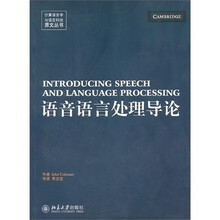
语音语言处理导论(附CD-ROM光盘1张)
目 录内容简介
导读
Acknowledgements and copyright notices
1 Introduction
1.1 About this book
1.2 Purpose of this book
1.3 Some reasons to use this book
1.4 What's in the book (and what's not)
1.5 Computational set-up needed for this book
1.6 Computational skills that are necessary in order to use the book
1.7 Free software suggestions
1.8 Book structure
Sounds and numbers
2.1 Preparatory assignments
2.2 Solutions
2.3 Sampling
2.4 Quantization
2.5 The sampling theorem
2.6 Generating a signal
2.7 Numeric data types
2.8 The program
2.9 Structure of a loop
2.10 Structure of an array
2.11 Calculating the cosine values
2.12 Structure of the program
2.13 Writing the signal to a file
Chapter summary
Further Exercises
Further reading
Digital filters and resonators
3.1 Operations on sequences of numbers
3.2 A program for calculating RMS amplitude
3.3 Filtering
3.4 A program for calculating running means of 4
3.5 Smoothing over a longer time-window
3.6 Avoiding the need for long window
3.7 IIR filters in C
3.8 Structure of the Klatt formant synthesizer
Chapter summary
Exercises
Further reading
Frequency analysis and linear predictive coding
4.1 Spectral analysis
4.2 Spectral analysis in C
4.3 Cepstral analysis
4.4 Computation of the cepstrum in C
4.5 Pitch tracking using cepstral analysis
4.6 Voicing detection
4.7 f0estimation by the autocorrelation method
4.8 Linear predictive coding
4.9 C programs for LPC analysis and resynthesis
4.10 Trying it out
4.11 Applications of LPC
Chapter Summary
Further exercises
Further reading
Finite-state machines
5. 1 Some simple examples
5.2 A more serious example
5.3 Deterministic and non-deterministic automata
5.4 Implementation in Prolog
5.5 Prolog's processing strategy and the treatment
of variables
5.6 Generating strings
5.7 Three possibly useful applications o{ that idea
5.8 Another approach to describing finite-state machines
5.9 Self-loops
5.10 Finite-state transducers(FSTs)
5.11 Using finite-state transducers to relate speech to phonemes
5.12 Finite-state phonology
5.13 Finite-state syntactic processing
Chapter summary
Further exercises
Further reading
Introduction to speech recognition techniques
6.1 Architectures for speech recognition
6.2 The pattern-recognition approach
6.3 Dynamic time warping
6.4 Applications
6.5 Sources of variability in speech
Chapter summary
Further reading
Probabilistic finite-state models
7.1 Introduction
7.2 Indeterminacy: n-gram models for part-of-speech tagging ~
7.3 Some probability theory for language modelling
7.4 Markov models
7.5 Trigram models
7.6 Incompleteness of the training corpus
7.7 Part-of-speech model calculations
7.8 Using HMMs for speech recognition
7.9 Chomsky's objections to Markov models and some rejoinders
Chapter summary
Further reading
Parsing
8.1 Introduction
8.9 A demo
8.3 Intuitive parsing
8.4 Recursive descent parsing
8.5 The simplest parsing program
8.6 Difference lists
8.7 Generating a parse tree
8.8 Syllabification
8.9 Other parsing algorithms
8.10 Chart parsing
8.11 Depth-first vs. breadth-first search
8.19 Deterministic parsing, Marcus parsing and minimal commitment parsing
8.13 Parallel parsing
Chapter summary
Further reading
Using probabilistie grammars
9.1 Motivations
9.2 Probabilistic context-free grammars
9.3 Estimation of rule probabilities
9.4 A practical example
9.5 A limitation of probabilistic context-free grammars
9.6 Tree adjoining grammars
……
Acknowledgements and copyright notices
1 Introduction
1.1 About this book
1.2 Purpose of this book
1.3 Some reasons to use this book
1.4 What's in the book (and what's not)
1.5 Computational set-up needed for this book
1.6 Computational skills that are necessary in order to use the book
1.7 Free software suggestions
1.8 Book structure
Sounds and numbers
2.1 Preparatory assignments
2.2 Solutions
2.3 Sampling
2.4 Quantization
2.5 The sampling theorem
2.6 Generating a signal
2.7 Numeric data types
2.8 The program
2.9 Structure of a loop
2.10 Structure of an array
2.11 Calculating the cosine values
2.12 Structure of the program
2.13 Writing the signal to a file
Chapter summary
Further Exercises
Further reading
Digital filters and resonators
3.1 Operations on sequences of numbers
3.2 A program for calculating RMS amplitude
3.3 Filtering
3.4 A program for calculating running means of 4
3.5 Smoothing over a longer time-window
3.6 Avoiding the need for long window
3.7 IIR filters in C
3.8 Structure of the Klatt formant synthesizer
Chapter summary
Exercises
Further reading
Frequency analysis and linear predictive coding
4.1 Spectral analysis
4.2 Spectral analysis in C
4.3 Cepstral analysis
4.4 Computation of the cepstrum in C
4.5 Pitch tracking using cepstral analysis
4.6 Voicing detection
4.7 f0estimation by the autocorrelation method
4.8 Linear predictive coding
4.9 C programs for LPC analysis and resynthesis
4.10 Trying it out
4.11 Applications of LPC
Chapter Summary
Further exercises
Further reading
Finite-state machines
5. 1 Some simple examples
5.2 A more serious example
5.3 Deterministic and non-deterministic automata
5.4 Implementation in Prolog
5.5 Prolog's processing strategy and the treatment
of variables
5.6 Generating strings
5.7 Three possibly useful applications o{ that idea
5.8 Another approach to describing finite-state machines
5.9 Self-loops
5.10 Finite-state transducers(FSTs)
5.11 Using finite-state transducers to relate speech to phonemes
5.12 Finite-state phonology
5.13 Finite-state syntactic processing
Chapter summary
Further exercises
Further reading
Introduction to speech recognition techniques
6.1 Architectures for speech recognition
6.2 The pattern-recognition approach
6.3 Dynamic time warping
6.4 Applications
6.5 Sources of variability in speech
Chapter summary
Further reading
Probabilistic finite-state models
7.1 Introduction
7.2 Indeterminacy: n-gram models for part-of-speech tagging ~
7.3 Some probability theory for language modelling
7.4 Markov models
7.5 Trigram models
7.6 Incompleteness of the training corpus
7.7 Part-of-speech model calculations
7.8 Using HMMs for speech recognition
7.9 Chomsky's objections to Markov models and some rejoinders
Chapter summary
Further reading
Parsing
8.1 Introduction
8.9 A demo
8.3 Intuitive parsing
8.4 Recursive descent parsing
8.5 The simplest parsing program
8.6 Difference lists
8.7 Generating a parse tree
8.8 Syllabification
8.9 Other parsing algorithms
8.10 Chart parsing
8.11 Depth-first vs. breadth-first search
8.19 Deterministic parsing, Marcus parsing and minimal commitment parsing
8.13 Parallel parsing
Chapter summary
Further reading
Using probabilistie grammars
9.1 Motivations
9.2 Probabilistic context-free grammars
9.3 Estimation of rule probabilities
9.4 A practical example
9.5 A limitation of probabilistic context-free grammars
9.6 Tree adjoining grammars
……
目 录内容简介
中国国内中俄翻译研究也不遑多让,大约在上世纪50年代中期便已开始。可惜的是,这些中文相关早期机器翻译研究,由于硬件与软件的限制,没能延续下来。中文计算语言学研究比较有系统的进展,还要等到1986年;海峡两岸在同一年成立了两个致力于中文计算语言学基础架构建立的研究群。北京大学的计算语言学研究所在朱德熙先生倡导下成立,随后一段时间由陆俭明、俞士汶主持。而台湾“中研院”的中文词知识库小组,由谢清俊创立,陈克健主持,黄居仁1987年返台后加入。
比价列表


公众号、微信群
 缺书网
缺书网微信公众号
 扫码进群
扫码进群实时获取购书优惠