

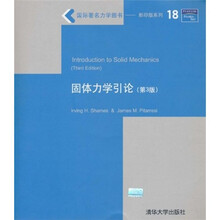
固体力学引论(第3版)
目 录内容简介
Preface ix
About the Authors xv
1 Fundamental Notions
1.1 Introduction
1.2 Fundamental Concepts
1.3 Vectors and Tensors
1.4 Force Distributions
1.5 A Note on Force and Mass
1.6 Closure
1.7 ALookBack
2 Stress
2.1 Introduction
2.2 Stress
2.3 Stress Notation
2.4 Complementary Property of Shear
2.5 A Comment on the Complementary Property of Shear
2.6 Equations of Equilibrium in Differential Form
2.7 Closure
2.8 A Look Ahead: Hydrostatics
Highlights (2)
3 strain
3.1 Introduction
3.2 The Displacement Field
3.3 Strain Components
3.4 Strains in Terms of the Displacement Field
3.5 Compatibility Considerations
3.6 Closure
3.7 A Look Ahead; Fluid Mechanics I
Highlights (3)
4 Introduction to Mechanical Properties of Solids
4.1 Introduction
4.2 The Tensile Test
4.3 Strain Hardening and Other Properties
4.4 Idealized One-Dimensional, Time Independent, Stress-Strain Laws
4.5 A Look Ahead; Viscoelasticity and Creep
4.6 Fatigue
4.7 Stress Concentration
4.8 One-Dimensional Thermal Stress
4.9 Closure
4.10 A Look Back
4.11 A LookAhead; Composite Materials
Highlights (4)
5 One-Dimensional Problems
5.1 Introduction lll
5.2 Basic Considerations
5.3 Statically Determinate Problems
5.4 Statically Indeterminate Problems
5.5 Residual Stress Problem
5.6 Design Problem
5.7 Thermoelastic Problems
5.8 Closure
5.9 A Look Ahead; Basic Laws of Continua
Highlights (5)
6 Generalized Hooke's Law and Introduction to Energy Methods
6.1 Introduction
Part A: Simple Constitutive Relations
6.2 Three-Dimensional Hooke's Law for Isotropic Materials
6.3 Relation Between the Three Material Constants
6.4 Nonisothermal Hooke's Law
6.5 Nonisotropic, Linear, Elastic Behavior: Generalized Hooke's Law
6.6 A Look Ahead; Fluid Mechanics II
Part B: Introduction to Energy Methods
6.7 Strain Energy
6.8 Castigliano's Second Theorem (Energy Methods I)
6.9 Basic Equations of Elasticity
6.10 Closure
6.11 A Look Ahead; Variational Methods
6.12 Highlights (6)
7 Plane stress
7.1 Introduction
7.2 Stress Variations at a Point for Plane Stress
7.3 A Pause and a Comment
7.4 Principal Stresses and Principal Axes
7.5 Mohr's Circle
7.6 Closure
Highlights (7)
8 Plane Strain
8.1 Introduction
8.2 A Look Back; Taylor Series and Directional Derivatives
8.3 Transformation Equations for Plane Strain
8.4 Properties of Plane Strain
8.5 A Pertinent Comment
8.6 Strain Gages
8.7 Closure
Highlights (8)
9 Failure Criteria
9.1 Introduction
9.2 Yield Criteria for Isotropic Ductile Materials
9.3 Yield Surfaces
9.4 Maximum Normal Stress Theory for Brittle Fracture
9.5 Comparison of the Theories
9.6 Closure
Highlights (9)
9.7 A Look Back; Equivalent Force Systems
10 Section Forces in Beams
10.1 Introduction
10.2 Shear Force, Axial Force,and Bending Moment
10.3 Direct Formulations of Shear and Bending-Moment Equations
10.4 Differential Relations for Bending Moment, Shear Force, and Load
10.5 Sketching Shear-Force and Bending-Moment Diagrams
10.6 Problems Requiring Equations and Diagrams
10.7 Additional Considerations
10.8 Closure
10.9 ALook Back
Highlights (10)
11 Stresses in Beams
11.1 Introduction
Part A: Basic Considerations
11.2 Pure Bending of Symmetric Beams
11.3 Bending of Symmetric Beams with Shear: Normal Stress
11.4 Bending of Symmetric Beams with Shear: Shear Stress
11.5 Determination of the Sign of the Shear Stress
11.6 Consideration of General Cuts
Part B: Special Topics
11.7 Composite Beams
11.8 Case of Unsymmetric Beams
11.9 Shear Stress in Beams of Narrow Open Cross Section
11.10 A Note on the Shear Center for Thin-Walled Open Members
11.11 Inelastic Behavior of Beams:The Elastic, Perfectly Plastic Case
11.12 A Note on the Failure of a Structure:Limit Design
11.13 Inelastic Behavior of Beams:Generalized Stress-Strain Relation
11.14 Stress Concentrations for Bending
11.15 Bending of Curved Beams
11.16 Closure
Highlights for Part A (11)
12 Deflection of Beams
12.1 Introduction
12.2 Differential Equations for Deflection of Symmetric Beams
12.3 Additional Problems
12.4 Statically Indeterminate Beams
12.5 Superposition Methods
12.6 Shear Deflection of Beams
12.7 Energy Methods for Beams
12.8 Closure
A Look Ahead: A Closer Look at Beam Deflection and Highlights (12)
13 Singularity Functions
13.1 Introduction
13.2 Delta Functions and Step Functions
13.3 Deflection Computations Using Singularity Functions
13.4 The Doublet Function
13.5 Closure
14 Torsion
14.1 Introduction
14.2 Circular Shafts
14.3 Torsion Problems Involving Circular Shafts
14.4 Stress Concentrations
14.5 Torsion of Thin-Walled Noncircular
Closed Shafts
14.6 Elastic, Perfectly Plastic Torsion
14.7 Noncircular Cross Sections
14.8 Strain Energy Computations for Twisting
14.9 Closure
Highlights (14)
15 Three-Dimensional Stress Properties at a Point
15.1 Introduction
15.2 Three-Dimensional Transformation Formulations for Stress
15.3 Principal Stresses for a General State of Stress
15.4 Tensor Invariants
15.5 A Look Ahead: Tensor Notation
15.6 Closure
Highlights (15)
16 Three-Dimensional Strain Relations at a Point
16.1 Introduction
16.2 Transformation Equations for Strain
16.3 Properties of Strain
16.4 Closure
Highlights (16)
17 Introduction to Elastic Stability
17.1 Introduction
17.2 Definition of Critical Load
17.3 A Note on Types of Elastic Instabilities
17.4 Beam-Column Equations
17.5 The Column: Buckling Loads
17.6 Looking Back as Well as Ahead
17.7 Solution of Beam-Column Problems
17.8 Initially Bent Member
17.9 Eccentrically Loaded Columns
17.10 General Considerations
17.11 Inelastic Column Theory
17.12 A Note on Column Formulas
17.13 Closure
17.14 A Look Ahead: Finite Elements
Highlights (17)
18 ENERGY METHODS
18.1 Introduction
Part A: Displacement Methods
18.2 Principal of Virtual Work
18.3 Method of Total Potential Energy
18.4 A Comment on the Total Potential Energy Method
18.5 The First Castigliano Theorem
Part B: Force Methods
18.6 Principal of Complementary Virtual Work
18.7 Complementary Potential Energy Principal
……
19Introduction to Finite Elements
Ⅰ.Deformation of Isotropic Materials
Ⅱ.Proof Using Tensor Notation that Strain Is a Second-Order Tensor
Ⅲ.A Note on the Maxwell-Bettl Theorem
Ⅳ.Tables
Ⅴ.Answers to Problems
Index
About the Authors xv
1 Fundamental Notions
1.1 Introduction
1.2 Fundamental Concepts
1.3 Vectors and Tensors
1.4 Force Distributions
1.5 A Note on Force and Mass
1.6 Closure
1.7 ALookBack
2 Stress
2.1 Introduction
2.2 Stress
2.3 Stress Notation
2.4 Complementary Property of Shear
2.5 A Comment on the Complementary Property of Shear
2.6 Equations of Equilibrium in Differential Form
2.7 Closure
2.8 A Look Ahead: Hydrostatics
Highlights (2)
3 strain
3.1 Introduction
3.2 The Displacement Field
3.3 Strain Components
3.4 Strains in Terms of the Displacement Field
3.5 Compatibility Considerations
3.6 Closure
3.7 A Look Ahead; Fluid Mechanics I
Highlights (3)
4 Introduction to Mechanical Properties of Solids
4.1 Introduction
4.2 The Tensile Test
4.3 Strain Hardening and Other Properties
4.4 Idealized One-Dimensional, Time Independent, Stress-Strain Laws
4.5 A Look Ahead; Viscoelasticity and Creep
4.6 Fatigue
4.7 Stress Concentration
4.8 One-Dimensional Thermal Stress
4.9 Closure
4.10 A Look Back
4.11 A LookAhead; Composite Materials
Highlights (4)
5 One-Dimensional Problems
5.1 Introduction lll
5.2 Basic Considerations
5.3 Statically Determinate Problems
5.4 Statically Indeterminate Problems
5.5 Residual Stress Problem
5.6 Design Problem
5.7 Thermoelastic Problems
5.8 Closure
5.9 A Look Ahead; Basic Laws of Continua
Highlights (5)
6 Generalized Hooke's Law and Introduction to Energy Methods
6.1 Introduction
Part A: Simple Constitutive Relations
6.2 Three-Dimensional Hooke's Law for Isotropic Materials
6.3 Relation Between the Three Material Constants
6.4 Nonisothermal Hooke's Law
6.5 Nonisotropic, Linear, Elastic Behavior: Generalized Hooke's Law
6.6 A Look Ahead; Fluid Mechanics II
Part B: Introduction to Energy Methods
6.7 Strain Energy
6.8 Castigliano's Second Theorem (Energy Methods I)
6.9 Basic Equations of Elasticity
6.10 Closure
6.11 A Look Ahead; Variational Methods
6.12 Highlights (6)
7 Plane stress
7.1 Introduction
7.2 Stress Variations at a Point for Plane Stress
7.3 A Pause and a Comment
7.4 Principal Stresses and Principal Axes
7.5 Mohr's Circle
7.6 Closure
Highlights (7)
8 Plane Strain
8.1 Introduction
8.2 A Look Back; Taylor Series and Directional Derivatives
8.3 Transformation Equations for Plane Strain
8.4 Properties of Plane Strain
8.5 A Pertinent Comment
8.6 Strain Gages
8.7 Closure
Highlights (8)
9 Failure Criteria
9.1 Introduction
9.2 Yield Criteria for Isotropic Ductile Materials
9.3 Yield Surfaces
9.4 Maximum Normal Stress Theory for Brittle Fracture
9.5 Comparison of the Theories
9.6 Closure
Highlights (9)
9.7 A Look Back; Equivalent Force Systems
10 Section Forces in Beams
10.1 Introduction
10.2 Shear Force, Axial Force,and Bending Moment
10.3 Direct Formulations of Shear and Bending-Moment Equations
10.4 Differential Relations for Bending Moment, Shear Force, and Load
10.5 Sketching Shear-Force and Bending-Moment Diagrams
10.6 Problems Requiring Equations and Diagrams
10.7 Additional Considerations
10.8 Closure
10.9 ALook Back
Highlights (10)
11 Stresses in Beams
11.1 Introduction
Part A: Basic Considerations
11.2 Pure Bending of Symmetric Beams
11.3 Bending of Symmetric Beams with Shear: Normal Stress
11.4 Bending of Symmetric Beams with Shear: Shear Stress
11.5 Determination of the Sign of the Shear Stress
11.6 Consideration of General Cuts
Part B: Special Topics
11.7 Composite Beams
11.8 Case of Unsymmetric Beams
11.9 Shear Stress in Beams of Narrow Open Cross Section
11.10 A Note on the Shear Center for Thin-Walled Open Members
11.11 Inelastic Behavior of Beams:The Elastic, Perfectly Plastic Case
11.12 A Note on the Failure of a Structure:Limit Design
11.13 Inelastic Behavior of Beams:Generalized Stress-Strain Relation
11.14 Stress Concentrations for Bending
11.15 Bending of Curved Beams
11.16 Closure
Highlights for Part A (11)
12 Deflection of Beams
12.1 Introduction
12.2 Differential Equations for Deflection of Symmetric Beams
12.3 Additional Problems
12.4 Statically Indeterminate Beams
12.5 Superposition Methods
12.6 Shear Deflection of Beams
12.7 Energy Methods for Beams
12.8 Closure
A Look Ahead: A Closer Look at Beam Deflection and Highlights (12)
13 Singularity Functions
13.1 Introduction
13.2 Delta Functions and Step Functions
13.3 Deflection Computations Using Singularity Functions
13.4 The Doublet Function
13.5 Closure
14 Torsion
14.1 Introduction
14.2 Circular Shafts
14.3 Torsion Problems Involving Circular Shafts
14.4 Stress Concentrations
14.5 Torsion of Thin-Walled Noncircular
Closed Shafts
14.6 Elastic, Perfectly Plastic Torsion
14.7 Noncircular Cross Sections
14.8 Strain Energy Computations for Twisting
14.9 Closure
Highlights (14)
15 Three-Dimensional Stress Properties at a Point
15.1 Introduction
15.2 Three-Dimensional Transformation Formulations for Stress
15.3 Principal Stresses for a General State of Stress
15.4 Tensor Invariants
15.5 A Look Ahead: Tensor Notation
15.6 Closure
Highlights (15)
16 Three-Dimensional Strain Relations at a Point
16.1 Introduction
16.2 Transformation Equations for Strain
16.3 Properties of Strain
16.4 Closure
Highlights (16)
17 Introduction to Elastic Stability
17.1 Introduction
17.2 Definition of Critical Load
17.3 A Note on Types of Elastic Instabilities
17.4 Beam-Column Equations
17.5 The Column: Buckling Loads
17.6 Looking Back as Well as Ahead
17.7 Solution of Beam-Column Problems
17.8 Initially Bent Member
17.9 Eccentrically Loaded Columns
17.10 General Considerations
17.11 Inelastic Column Theory
17.12 A Note on Column Formulas
17.13 Closure
17.14 A Look Ahead: Finite Elements
Highlights (17)
18 ENERGY METHODS
18.1 Introduction
Part A: Displacement Methods
18.2 Principal of Virtual Work
18.3 Method of Total Potential Energy
18.4 A Comment on the Total Potential Energy Method
18.5 The First Castigliano Theorem
Part B: Force Methods
18.6 Principal of Complementary Virtual Work
18.7 Complementary Potential Energy Principal
……
19Introduction to Finite Elements
Ⅰ.Deformation of Isotropic Materials
Ⅱ.Proof Using Tensor Notation that Strain Is a Second-Order Tensor
Ⅲ.A Note on the Maxwell-Bettl Theorem
Ⅳ.Tables
Ⅴ.Answers to Problems
Index
目 录内容简介
《固体力学引论(第3版)》把固体力学的基本概念、基本原理和常用公式提取出来,采用物理概念加简明数学推导的讲授方法,不追求理论的完整性和系统性,不要求学生掌握用解析方法求解固体力学二维、三维问题的能力,而把重点放在正确理解概念和合理应用基本原理及常用公式去解决工程问题。
《固体力学引论(第3版)》像一本拓展了的材料力学教材,按基础课的要求把固体力学和材料力学两者融为一体、选其精华,是一本颇有特色的教材,目前已经是第5版。作者有丰富的教学经验,曾写过不少优秀教材,《固体力学引论(第3版)》对我国工程专业力学系列课程的教学改革具有参考意义。
《固体力学引论(第3版)》可以作为我国材料力学、工程力学和弹性力学课程的英文教材或教学参考书。
《固体力学引论(第3版)》像一本拓展了的材料力学教材,按基础课的要求把固体力学和材料力学两者融为一体、选其精华,是一本颇有特色的教材,目前已经是第5版。作者有丰富的教学经验,曾写过不少优秀教材,《固体力学引论(第3版)》对我国工程专业力学系列课程的教学改革具有参考意义。
《固体力学引论(第3版)》可以作为我国材料力学、工程力学和弹性力学课程的英文教材或教学参考书。
比价列表


公众号、微信群
 缺书网
缺书网微信公众号
 扫码进群
扫码进群实时获取购书优惠