

第七届国际认知科学大会论文集(英文)
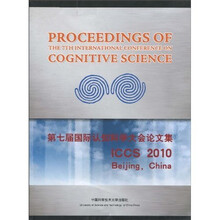
作者:第七届国际认知科学大会组委会 编
出版:中国科学技术大学出版社 2010.8
页数:468
定价:198.00 元
ISBN-13:9787312027307
ISBN-10:731202730X 去豆瓣看看
出版:中国科学技术大学出版社 2010.8
页数:468
定价:198.00 元
ISBN-13:9787312027307
ISBN-10:731202730X 去豆瓣看看
目 录内容简介
PartⅠ Opening Ceremony Speeches
1 Neural Basis for Selective Visual Attention
2.Modelling Visual Attention in a Biologically Plausible System: Bridging the Gap between Physiology and Cognition
3.Spike Timing-Dependent Plasticity of Neural Circuits-Hebb's Postulate Revisited
4.Brain Mechanisms Underlying the Intuitive Thinking in Board-Game Experts
5.A Conspiracy Theory of Learning to Read Chinese: Mapping the Educated Eyes to the Educated Brain
PartⅡ Frontiers in Congnitive Science
Section 1 Presidential Symposium on Vision
1.The Global-first Topological Definition of Perceptual Objects, and Its Neural Correlation in Anterior Temporal Lobe
2.Examining Cortical Circuitry Subserving Working Memory for Visual Motion
3.Binocular Rivalry: Mechanisms and Applications
4.Fast and Rrobust Processing of Visual Information From Field Potentials in the Human Temporal Visual Cortex
5.Imaging Attention in the Brain: Optical Imaging Studies of Area V4 in Awake, Behaving Macaque Monkeys
6.Seeing the Functional Role of Adaptation
Section 2 Attention
Symposium 1 Intentions in the Mind/Brain
1.The Intentionality Network
2.From Social Intention to Action: Kinematic Evidence of Social Planning and Control
3.Inferring Intentions from Biological Motion
4.Minds Made for Sharing? An fMRI Investigation of the Neural Correlates of Joint Attention
Symposium 2 A General Theory of Visual Attention (TVA) ~ Cognitive Modeling and Neuropsychological Applications
1.Modulation of Working Memory Related Neural Activity Bydistraction
2.TVA Based Studies of Dyslexia
3.TVA Based Studies on the Neurogenetics of Cognition
4.Neuro-Cognitive Markers of Progressive Attentional Decline in Neurodegenerative Diseases: Parametric Assessment Based on Bundesen's Theory of Visual Attention (TVA)
5.The NTVA Framework: Linking Cognition and Neuroscienee
6.Attentional Capture and Control: Computation of Attentional Weights
7.Top-Down Suppression from Prefrontal to Primary Somatosensory Cortex Facilitates Tactile
8.Modeling Attentional Dwell-Time
9.Towards a Neural Theory of Visual Attention in Perception and Sensori Motor Control (TVA-M)
10.Testing Theories of Pure Alexia Using TVA
11.Examining Spatial Properties from Multiple Views
12.Quantifying Visual Attention: TVA-Based Assessment of Distinct Components of Visual Attention
Symposium 3 Neural Correlates of Attention and Meditation
1.Brain Activation during Development
2.Children 3 - 8 Years of Age= Evidence from ERPs
3.The Effects of Working Memory Training and Processing Speed Training on Neural Systems and Cognitive Functions
4.Neural Correlates of Attention Training and Meditation Practice
5.The Early Attentional Modulation of C1 Component-High Perceptual Load Preferred, but Attentional Load not Crucial
Section 3 Language
Plenary Speech
1.Social Intelligence as a Domain-Specific Module and the Emergence of I.anguage
2.Developmental Dyslexia in Chinese and English
Symposium 1 Cognitive Neuroscience of I.anguage
1.Characterizing Ventral Occipito-Temporal Contributions to Reading
2.Neural Substrates of I.exical Tone as Revealed at Different Stages of Cortical and Subcortical Processing
3.Understanding Dynamic Interacting Neural Networks: Applications to Speech and Language
4.Auditory Memory, I.ead I.ag Integration, and Speech Unmasking in Noisy, Reverberant Environments
5.The Architecture of Speech Perception and Its Temporal Foundations
6.Evidence Against a Dedicated System for Visual Word Forms in the Fusiform Gyrus
Symposium 2 Cognitive Processes and Representation of Asian Languages
1. The Phonological Process with two Patterns of Chinese Characters
Symposium 3 Universality and Language-specificity of Sound Symbolism. the Interplay of
Multimodality, Embodiment, and Iconicity
1.The Cognitive Semantics of Onomatopoeia: A Crosslinguistic Perspective on the Lexical Integration of
Sound Symbolism
2.Sound Symbolism on Touch
3.Parallel Relationship between Sound Symbolism and Cross-Modal Correspondence
4. Neural Priming of Action Concept: fMRI Adaptation for Action Words
5.Mimetics and Verb Learning= a Discourse Analysis of Verbs Introduced with Mimetic Verbs
Symposium 4 Enhancing Electronic Dictionaries with the Help of Lexicographers, Computer
Scientists and Cognitive Psychologists
1.A Proposal for Obtaining the Knowledge Base of Onomasiological Dictionaries "
2.Word Sense Disambiguation Using Associative Concept Dictionary
3.Utilizing the Distributional Hypothesis for Multilingual Thesaurus Construction
4.EvaluatingStatistical Models for Basic I.exieon
5.The Mental Lexicon, Blueprint of Tomorrow's Electronic Dictionaries
Section 4 Animal Cognition
1.Accessing the Neural Bases of Cognitive Processing: Lessons from an Insect Brain
Symposium 1 Animal Cognition——Intelligent Behavior Emerging from a Small Brain
1.MAPK Cascades in Rat Anterior Cingulate Cortex Contribute to Induction and Expression of Pain-Related
Emotion
2.Emotional Learning Enhances Stimulus-Specific Top-Down Modulation of Sensorimotor Gating in Socially
Reared Rats But Not Isolation-Reared Rats
3.Face Processing by Honeybees~ How Does Brightness Inversion Affect the Capacity of the Miniature Brain to Bind
and Configure Spatial Elements for Reliable Recognition?
4.Differential Roles of the Fan-Shaped Body and the Ellipsoid Body in Drosophila Visual Pattern Memory
5.Deep Sequencing-Based Transcriptome Profiling Reveals the Differences between Foraging and
Dancingbehavior in the Honey Bee, Apis Mellifera
6.Vision of Bees in Relation to Flower Patterns
7.Selective Visual Attention in Drosophila during Tethered Flight
8.Small Brains, Smart Minds: New Evidence of Higher Cognitive Function Emerging from the Small Brain
9.Investigating Episodic Memory in Rats
Symposium 2 Animal Cognition.. Nonhuman Primates Studies
1.Visuospatial Properties of Caudal 7b in the Monkey
2.AdaptiveVisual Processing in the Primary Visual Cortex
3.The Cortical Functional Organizations for Illusory and Kinetic Contour Processingacross V1, V2 and V4 of
Macaque Ventral Pathway
Section 5 Early Development on Face Processing
1.The Development of Specialization in Face Processing
2.Emergenceof the Own-Race Advantage in Taiwanese Infants.. Rethinking Perceptual Narrowing in a Developing Visual System
3.Emergence and Development of the Other-Race Effect in Infancy and Early Childhood
4.Infants' Knowledge of Their Own Species
5.Body Inversion Effect: a Qualitative Change or a Quantitative Change
Section 6 Philosophy of Mind. Computation and Cognition
1.Can Computationalism Avoid the Triviality Problem? The Triviality Arguments and Implementation in
Cognitive Science
2.Why the Mind Is Not Computational?
3.A Computational Explanation of Intentionality
4.The Representation-Computation Metaphor and the Embodiment-Interaction Metaphor
5.Information Processing, Computation, and Cognition
6.How to Tell a Propositional-Attitude-Eliminating Story on Cognition without Eliminating Contents? -"
7.Fodor's Worry
Section 7 Higher Levels of Cognition
1.The Influence of Working Memory on Transfer of Incompatible Iocation-Relevant Mapping on a
Subsequent Simon Task
2.What is the Smallest Number of Premises in Inductive Decision-Making under Uncertainty In Daily Life?
3.Order-Effected Verification Bias and the "Denial Antecedent Error
4.The Development of Cognitive Abilities in Chinese Children
5.How Does Anxiety Affect Decision-Making
6.Neural Correlates of "Aha" Experiences during Insight Problem Solving
7.Inferior Frontal Gyrus Was Activated During Sentence-Level Semantic Unification in Both Explicit and Implicit Reading Tasks
8.Rapid Processing of both Reward Probability and Reward Uncertainty in the Human
Anterior Cingulate Cortex
PartⅢ Impacts of Cognitive Science
Section 1 Cognitive Science and Brain Mapping
Workshop Neuro MR Insights Into the Brain
1 Opportunities and Challenges of High Field MRI and MRS
2.Ultrafast Functional Magnetic Resonance
3.Sounds and Music.- fMRI of the Auditory System
4,Gains and Losses of 7T MRI for Imaging Neuroseience
Symposium 1 Brain Imaging and Signal Processing Methods
1.A Kalman Smoother-Based Approach for Estimating Time-Varying Cortical Connectivity from High-Density EEG
2.An Aadaptive Algorithm of Second Order Blind Identification (SOBI) with Reference
3.Taking into Account Latency, Amplitude and Morphology: Improved Estimation of Single-Trial
EEG/MEG Responses by Wavelet Filtering and Multiple Linear Regression
4.A Network Graphical Analysis Approach Demonstrates Different Connectivity Patterns Across
Disease Subtypes in Parkinson's Disease (PD)
5.Likelihood Unmndality of a State-Space Model with Point Process Observations for Neural Spike
Train Modeling
6.Multiblock PLS Model for Group Analysis Detects Ipsilateral Cerebellum and Globus Pallidus
Hyperactivity in Parkinson Disease
Symposium 2 ASL Perfusion MRI in Cognitive and Clinical Neuroscience
Symposium 3 Mutlimodal Brain Mapping Methods Overview
1. Electrocorticography (ECOG) in Functional Cognitive Studies
……
PartⅣ Special Events
PartⅤ Special Events
1 Neural Basis for Selective Visual Attention
2.Modelling Visual Attention in a Biologically Plausible System: Bridging the Gap between Physiology and Cognition
3.Spike Timing-Dependent Plasticity of Neural Circuits-Hebb's Postulate Revisited
4.Brain Mechanisms Underlying the Intuitive Thinking in Board-Game Experts
5.A Conspiracy Theory of Learning to Read Chinese: Mapping the Educated Eyes to the Educated Brain
PartⅡ Frontiers in Congnitive Science
Section 1 Presidential Symposium on Vision
1.The Global-first Topological Definition of Perceptual Objects, and Its Neural Correlation in Anterior Temporal Lobe
2.Examining Cortical Circuitry Subserving Working Memory for Visual Motion
3.Binocular Rivalry: Mechanisms and Applications
4.Fast and Rrobust Processing of Visual Information From Field Potentials in the Human Temporal Visual Cortex
5.Imaging Attention in the Brain: Optical Imaging Studies of Area V4 in Awake, Behaving Macaque Monkeys
6.Seeing the Functional Role of Adaptation
Section 2 Attention
Symposium 1 Intentions in the Mind/Brain
1.The Intentionality Network
2.From Social Intention to Action: Kinematic Evidence of Social Planning and Control
3.Inferring Intentions from Biological Motion
4.Minds Made for Sharing? An fMRI Investigation of the Neural Correlates of Joint Attention
Symposium 2 A General Theory of Visual Attention (TVA) ~ Cognitive Modeling and Neuropsychological Applications
1.Modulation of Working Memory Related Neural Activity Bydistraction
2.TVA Based Studies of Dyslexia
3.TVA Based Studies on the Neurogenetics of Cognition
4.Neuro-Cognitive Markers of Progressive Attentional Decline in Neurodegenerative Diseases: Parametric Assessment Based on Bundesen's Theory of Visual Attention (TVA)
5.The NTVA Framework: Linking Cognition and Neuroscienee
6.Attentional Capture and Control: Computation of Attentional Weights
7.Top-Down Suppression from Prefrontal to Primary Somatosensory Cortex Facilitates Tactile
8.Modeling Attentional Dwell-Time
9.Towards a Neural Theory of Visual Attention in Perception and Sensori Motor Control (TVA-M)
10.Testing Theories of Pure Alexia Using TVA
11.Examining Spatial Properties from Multiple Views
12.Quantifying Visual Attention: TVA-Based Assessment of Distinct Components of Visual Attention
Symposium 3 Neural Correlates of Attention and Meditation
1.Brain Activation during Development
2.Children 3 - 8 Years of Age= Evidence from ERPs
3.The Effects of Working Memory Training and Processing Speed Training on Neural Systems and Cognitive Functions
4.Neural Correlates of Attention Training and Meditation Practice
5.The Early Attentional Modulation of C1 Component-High Perceptual Load Preferred, but Attentional Load not Crucial
Section 3 Language
Plenary Speech
1.Social Intelligence as a Domain-Specific Module and the Emergence of I.anguage
2.Developmental Dyslexia in Chinese and English
Symposium 1 Cognitive Neuroscience of I.anguage
1.Characterizing Ventral Occipito-Temporal Contributions to Reading
2.Neural Substrates of I.exical Tone as Revealed at Different Stages of Cortical and Subcortical Processing
3.Understanding Dynamic Interacting Neural Networks: Applications to Speech and Language
4.Auditory Memory, I.ead I.ag Integration, and Speech Unmasking in Noisy, Reverberant Environments
5.The Architecture of Speech Perception and Its Temporal Foundations
6.Evidence Against a Dedicated System for Visual Word Forms in the Fusiform Gyrus
Symposium 2 Cognitive Processes and Representation of Asian Languages
1. The Phonological Process with two Patterns of Chinese Characters
Symposium 3 Universality and Language-specificity of Sound Symbolism. the Interplay of
Multimodality, Embodiment, and Iconicity
1.The Cognitive Semantics of Onomatopoeia: A Crosslinguistic Perspective on the Lexical Integration of
Sound Symbolism
2.Sound Symbolism on Touch
3.Parallel Relationship between Sound Symbolism and Cross-Modal Correspondence
4. Neural Priming of Action Concept: fMRI Adaptation for Action Words
5.Mimetics and Verb Learning= a Discourse Analysis of Verbs Introduced with Mimetic Verbs
Symposium 4 Enhancing Electronic Dictionaries with the Help of Lexicographers, Computer
Scientists and Cognitive Psychologists
1.A Proposal for Obtaining the Knowledge Base of Onomasiological Dictionaries "
2.Word Sense Disambiguation Using Associative Concept Dictionary
3.Utilizing the Distributional Hypothesis for Multilingual Thesaurus Construction
4.EvaluatingStatistical Models for Basic I.exieon
5.The Mental Lexicon, Blueprint of Tomorrow's Electronic Dictionaries
Section 4 Animal Cognition
1.Accessing the Neural Bases of Cognitive Processing: Lessons from an Insect Brain
Symposium 1 Animal Cognition——Intelligent Behavior Emerging from a Small Brain
1.MAPK Cascades in Rat Anterior Cingulate Cortex Contribute to Induction and Expression of Pain-Related
Emotion
2.Emotional Learning Enhances Stimulus-Specific Top-Down Modulation of Sensorimotor Gating in Socially
Reared Rats But Not Isolation-Reared Rats
3.Face Processing by Honeybees~ How Does Brightness Inversion Affect the Capacity of the Miniature Brain to Bind
and Configure Spatial Elements for Reliable Recognition?
4.Differential Roles of the Fan-Shaped Body and the Ellipsoid Body in Drosophila Visual Pattern Memory
5.Deep Sequencing-Based Transcriptome Profiling Reveals the Differences between Foraging and
Dancingbehavior in the Honey Bee, Apis Mellifera
6.Vision of Bees in Relation to Flower Patterns
7.Selective Visual Attention in Drosophila during Tethered Flight
8.Small Brains, Smart Minds: New Evidence of Higher Cognitive Function Emerging from the Small Brain
9.Investigating Episodic Memory in Rats
Symposium 2 Animal Cognition.. Nonhuman Primates Studies
1.Visuospatial Properties of Caudal 7b in the Monkey
2.AdaptiveVisual Processing in the Primary Visual Cortex
3.The Cortical Functional Organizations for Illusory and Kinetic Contour Processingacross V1, V2 and V4 of
Macaque Ventral Pathway
Section 5 Early Development on Face Processing
1.The Development of Specialization in Face Processing
2.Emergenceof the Own-Race Advantage in Taiwanese Infants.. Rethinking Perceptual Narrowing in a Developing Visual System
3.Emergence and Development of the Other-Race Effect in Infancy and Early Childhood
4.Infants' Knowledge of Their Own Species
5.Body Inversion Effect: a Qualitative Change or a Quantitative Change
Section 6 Philosophy of Mind. Computation and Cognition
1.Can Computationalism Avoid the Triviality Problem? The Triviality Arguments and Implementation in
Cognitive Science
2.Why the Mind Is Not Computational?
3.A Computational Explanation of Intentionality
4.The Representation-Computation Metaphor and the Embodiment-Interaction Metaphor
5.Information Processing, Computation, and Cognition
6.How to Tell a Propositional-Attitude-Eliminating Story on Cognition without Eliminating Contents? -"
7.Fodor's Worry
Section 7 Higher Levels of Cognition
1.The Influence of Working Memory on Transfer of Incompatible Iocation-Relevant Mapping on a
Subsequent Simon Task
2.What is the Smallest Number of Premises in Inductive Decision-Making under Uncertainty In Daily Life?
3.Order-Effected Verification Bias and the "Denial Antecedent Error
4.The Development of Cognitive Abilities in Chinese Children
5.How Does Anxiety Affect Decision-Making
6.Neural Correlates of "Aha" Experiences during Insight Problem Solving
7.Inferior Frontal Gyrus Was Activated During Sentence-Level Semantic Unification in Both Explicit and Implicit Reading Tasks
8.Rapid Processing of both Reward Probability and Reward Uncertainty in the Human
Anterior Cingulate Cortex
PartⅢ Impacts of Cognitive Science
Section 1 Cognitive Science and Brain Mapping
Workshop Neuro MR Insights Into the Brain
1 Opportunities and Challenges of High Field MRI and MRS
2.Ultrafast Functional Magnetic Resonance
3.Sounds and Music.- fMRI of the Auditory System
4,Gains and Losses of 7T MRI for Imaging Neuroseience
Symposium 1 Brain Imaging and Signal Processing Methods
1.A Kalman Smoother-Based Approach for Estimating Time-Varying Cortical Connectivity from High-Density EEG
2.An Aadaptive Algorithm of Second Order Blind Identification (SOBI) with Reference
3.Taking into Account Latency, Amplitude and Morphology: Improved Estimation of Single-Trial
EEG/MEG Responses by Wavelet Filtering and Multiple Linear Regression
4.A Network Graphical Analysis Approach Demonstrates Different Connectivity Patterns Across
Disease Subtypes in Parkinson's Disease (PD)
5.Likelihood Unmndality of a State-Space Model with Point Process Observations for Neural Spike
Train Modeling
6.Multiblock PLS Model for Group Analysis Detects Ipsilateral Cerebellum and Globus Pallidus
Hyperactivity in Parkinson Disease
Symposium 2 ASL Perfusion MRI in Cognitive and Clinical Neuroscience
Symposium 3 Mutlimodal Brain Mapping Methods Overview
1. Electrocorticography (ECOG) in Functional Cognitive Studies
……
PartⅣ Special Events
PartⅤ Special Events
目 录内容简介
第七届国际认知科学大会在北京开幕。来自全球二十多个国家和地区的数百名科学家在此次会议上共同探讨和交流认知科学前沿问题。大会组织了认知科学与脑成像、认知科学与教育、认知科学与精神健康、认知科学与信息科学、认知科学与社会科学等五大方面的学术报告。各国科学家们将讨论涉及认知科学的各种前沿科学问题,并特别突出认知科学高度跨学科的特点。
比价列表


公众号、微信群
 缺书网
缺书网微信公众号
 扫码进群
扫码进群实时获取购书优惠