

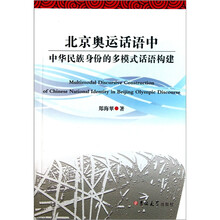
北京奥运话语中中华民族身份的多模式话语构建
Chapter 1 Introduction
1.1 Contemporary communication
1.2 Sports and national identity
1.3 Beijing Olympic Games and Chinese national identity
1.4 The structure of the thesis
Chapter 2 Nation, Nationalism and National Identity
2.1 Identity studies: from essentialism to constmctionism
2.2 Related concepts to national identity
2.2.1 Different approaches to nation
2.2.1.1 Nation as a historical development
2.2.1.2 Nation as an imagined community
2.2.1.3 Nation as a cognitive category
2.2.2 State and nation - state
2, 2.3 Nationalism
2.2.4 Definition of national identity
2.3 Assumptions about national identity
2.3.1 National identity as social identity
2.3.2 National identity as collective identity
2.3.3 National identity: An interactive construct
2.3.4 Multi - dimensional representation of national
identity
2.3.5 Multiple empirical referents to national identity
2.4 The discursive construction of national identity
2.5 Current researches on Chinese national identity
2.6 Towards multimodal discursive construction of national
identity
Chapter 3 Multirnodality Research: A New Frontier for Multi -semio
Meaning Making
3.1 Studies of semiotic meaning - making mechanism
3.1.1 Founding fathers of semiotics revisited
3.1.1. I Saussure‘ s linguicentric semiology
3.1.1.2 Peirce’ s semiotics: logic - oriented theory
about signs
3.1.2 Social semiotics
3.1.2.1 Social interpretation of meaning
3.1.2.2 Multiplicity of meaning - making resources
3.1.2.3 Social theory of signs
3.1.2.4 Semiosis and the social
3.1.3 Summary
3.2 Critical discourse analysis: discourse as social practice
3.2.1 Fairclough: The distinction between Discourse (s)
and discourse (s)
3.2.2 Wodak: discourse as a macro -topic concept and
a particular occurrence
3.2.3 Van Dijk: a multidisciplinary notion of discourse
3.2.4 Kress and Van Leeuwen: discourse as the semiosic
plane in semiosis
3.2.5 Summary
3.3 Critical social semiotics
3.3.1 Multimodal theory of communication
3.3.2 Modes and media
3.3.3 Multimodal text
3.3.4 Multiple articulation of meaning
3.3.5 Reflections on Kress and Van Leeuwen‘ s
multimodal theory
Chapter 4 Proposed Frameworks for Multimodal Discourse Analysis
4.1 Multimodal realization of discourse
4.1.1 Mode identification
4.1.2 Mode involvement
4.1.3 Mode interaction
4.1.4 Strategy and multimodal discourse as social
practice
4.2 A three - stage meaning - making model
4.2.1 Cultivation
4.2.2 Realization
4.2.3 Distribution
4.2.4 Relationship between the three stages
Chapter 5 Multimodal Discursive Construction of Chinese
National Identity
5.1 A plethora of multi - semiotic resources as data
5.2 Multimodal realization of Chinese national identity
5.2.1 Modes, sub - modes and media deployed
5.2.1.1 Language
5.2.1.2 Sub - modes of language
5.2.1.3 Image
5.2. 1.4 Music
5.2.1.5 Dress
5.2.1.6 Color
5.2.1.7 Number
5.2.1.8 Media
5.2.2 Mode involvement
5.2.3 Intersemiosis
5.2.3.1 The bidding logo and its caption
5.2.3.2 Intersemiosis in people’ s signatures
5.2.3.3 A middle school student‘ s paper cranes and verbal hope
5.2.3.4 Overseas Chinese’ s Wish Cup and open letter
5.2.3.5 Overseas Chinese displaying “Olympic Dragon” Scroll
5.2.3.6 Interaction between semiotic modes in presentation
5.2.3.7 Fuwa: A kaleidoscope of the Chinese
culture
5.2.4 Strategy
5.2.5 Summary
5.3 The Beijing Olympic emblem: An illustration of three - stage multimodal meaning making
5.3.1 Cultivation: digging Chinese culture
5.3.1.1 Design expectation: China aiming to be unique
5.3.1.2 Combining Chinese civilization with Olympic philosophy in the design
5.3.1.3 The design - modifying: A Chinese culture learning process
5.3.2 Realization: A witness of the Chinese nation‘ s commitment
5.3.2.1 The visual image of the emblem: a multimodal
construct
5.3.2.2 Multimodal realization of the emblem seal
5.3.2.3 Unveiling: an aggregate of signs
5.3.3 Distribution: meaning enhanced and enriched
5.3.3.1 Rogge giving approval in a Chinese way
5.3.3.2 International Comments
5.3.3.3 Chinese official interpretation
5.3.3.4 Chinese experts’ evaluations
5.3.3.5 Other Chinese people‘ s understanding
5.3.3.6 Summary
5.3.4 Chinese Seal -Dancing Beijing and Chinese national
identity
5.4 Discussion
5.4.1 Chinese national identity as a multimodal discursive construct
5.4.2 Multi - dimensional representation of Chinese national identity
5.4.3 Multiple empirical referents to Chinese national identity
Chapter 6 Conclusion
Bibliography
Appendix: Data source
1.1 Contemporary communication
1.2 Sports and national identity
1.3 Beijing Olympic Games and Chinese national identity
1.4 The structure of the thesis
Chapter 2 Nation, Nationalism and National Identity
2.1 Identity studies: from essentialism to constmctionism
2.2 Related concepts to national identity
2.2.1 Different approaches to nation
2.2.1.1 Nation as a historical development
2.2.1.2 Nation as an imagined community
2.2.1.3 Nation as a cognitive category
2.2.2 State and nation - state
2, 2.3 Nationalism
2.2.4 Definition of national identity
2.3 Assumptions about national identity
2.3.1 National identity as social identity
2.3.2 National identity as collective identity
2.3.3 National identity: An interactive construct
2.3.4 Multi - dimensional representation of national
identity
2.3.5 Multiple empirical referents to national identity
2.4 The discursive construction of national identity
2.5 Current researches on Chinese national identity
2.6 Towards multimodal discursive construction of national
identity
Chapter 3 Multirnodality Research: A New Frontier for Multi -semio
Meaning Making
3.1 Studies of semiotic meaning - making mechanism
3.1.1 Founding fathers of semiotics revisited
3.1.1. I Saussure‘ s linguicentric semiology
3.1.1.2 Peirce’ s semiotics: logic - oriented theory
about signs
3.1.2 Social semiotics
3.1.2.1 Social interpretation of meaning
3.1.2.2 Multiplicity of meaning - making resources
3.1.2.3 Social theory of signs
3.1.2.4 Semiosis and the social
3.1.3 Summary
3.2 Critical discourse analysis: discourse as social practice
3.2.1 Fairclough: The distinction between Discourse (s)
and discourse (s)
3.2.2 Wodak: discourse as a macro -topic concept and
a particular occurrence
3.2.3 Van Dijk: a multidisciplinary notion of discourse
3.2.4 Kress and Van Leeuwen: discourse as the semiosic
plane in semiosis
3.2.5 Summary
3.3 Critical social semiotics
3.3.1 Multimodal theory of communication
3.3.2 Modes and media
3.3.3 Multimodal text
3.3.4 Multiple articulation of meaning
3.3.5 Reflections on Kress and Van Leeuwen‘ s
multimodal theory
Chapter 4 Proposed Frameworks for Multimodal Discourse Analysis
4.1 Multimodal realization of discourse
4.1.1 Mode identification
4.1.2 Mode involvement
4.1.3 Mode interaction
4.1.4 Strategy and multimodal discourse as social
practice
4.2 A three - stage meaning - making model
4.2.1 Cultivation
4.2.2 Realization
4.2.3 Distribution
4.2.4 Relationship between the three stages
Chapter 5 Multimodal Discursive Construction of Chinese
National Identity
5.1 A plethora of multi - semiotic resources as data
5.2 Multimodal realization of Chinese national identity
5.2.1 Modes, sub - modes and media deployed
5.2.1.1 Language
5.2.1.2 Sub - modes of language
5.2.1.3 Image
5.2. 1.4 Music
5.2.1.5 Dress
5.2.1.6 Color
5.2.1.7 Number
5.2.1.8 Media
5.2.2 Mode involvement
5.2.3 Intersemiosis
5.2.3.1 The bidding logo and its caption
5.2.3.2 Intersemiosis in people’ s signatures
5.2.3.3 A middle school student‘ s paper cranes and verbal hope
5.2.3.4 Overseas Chinese’ s Wish Cup and open letter
5.2.3.5 Overseas Chinese displaying “Olympic Dragon” Scroll
5.2.3.6 Interaction between semiotic modes in presentation
5.2.3.7 Fuwa: A kaleidoscope of the Chinese
culture
5.2.4 Strategy
5.2.5 Summary
5.3 The Beijing Olympic emblem: An illustration of three - stage multimodal meaning making
5.3.1 Cultivation: digging Chinese culture
5.3.1.1 Design expectation: China aiming to be unique
5.3.1.2 Combining Chinese civilization with Olympic philosophy in the design
5.3.1.3 The design - modifying: A Chinese culture learning process
5.3.2 Realization: A witness of the Chinese nation‘ s commitment
5.3.2.1 The visual image of the emblem: a multimodal
construct
5.3.2.2 Multimodal realization of the emblem seal
5.3.2.3 Unveiling: an aggregate of signs
5.3.3 Distribution: meaning enhanced and enriched
5.3.3.1 Rogge giving approval in a Chinese way
5.3.3.2 International Comments
5.3.3.3 Chinese official interpretation
5.3.3.4 Chinese experts’ evaluations
5.3.3.5 Other Chinese people‘ s understanding
5.3.3.6 Summary
5.3.4 Chinese Seal -Dancing Beijing and Chinese national
identity
5.4 Discussion
5.4.1 Chinese national identity as a multimodal discursive construct
5.4.2 Multi - dimensional representation of Chinese national identity
5.4.3 Multiple empirical referents to Chinese national identity
Chapter 6 Conclusion
Bibliography
Appendix: Data source
郑海翠。女,1971年生,内蒙古人,蒙古族。2003年毕业于苏州大学外国语学院,获英语语言文学硕士学位。2008年毕业于南开大学外国语学院,获英语语言文学博士学位。现为内蒙古大学外国语学院教师。副教授。具体研究方向为(批评)话语分析、社会语言学、语用学等。近年来,在国际话语核心期刊DiscourseStudies、《外语学刊》、《中国社会语言学》、《中国英语教学》等学术期刊发表过学术论文。参与过国家社科基金项目的研究。
比价列表


公众号、微信群
 缺书网
缺书网微信公众号
 扫码进群
扫码进群实时获取购书优惠