

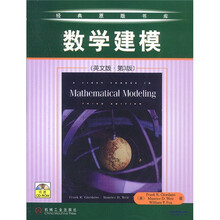
数学建模(英文版第3版)(附光盘)
目 录内容简介
1 modeling change
introduction
example 1: testing for proportionality
1.1 modeling change with difference equations
example i: a savings certificate
example 2: mortgaging a home
1.2 approximating change with difference equations
example 1: growth of a yeast culture
example 2: growth of a yeast culture revisited
example 3: spread of a contagious disease
example 4: decay of digoxin in the bloodstream
example 5: heating of a cooled object
1.3 solutions to dynamical systems
example 1: a savings certificate revisited
example 2: sewage treatment
example 3: prescription for digoxin
example 4: an investment annuity
example 5: a checking account
example 6: an investment annuity revisited
1.4 systems of difference equations
example i: a car rental company
example 2: the battle of trafalgar
example 3: competitive hunter model——spotted owls and hawks
example 4: voting tendencies of the political parties
2 the modeling process, proportionality, and geometric similarity introduction
2.1 mathematical models
example 1: vehicular stopping distance
2.2 modeling using proportionality
example 1: kepler's third law
2.3 modeling using geometric similarity
example 1: raindrops from a motionless cloud
example 2: modeling a bass fishing derby
2.4 automobile gasoline mileage
2.5 body weight and height, strength and agility
model fitting
introduction
3.1 fitting models to data graphically
3.2 analytic methods of model fitting
3.3 applying the least-squares criterion
3.4 choosing a best model
example 1: vehicular stopping distance
4 experimental modeling
introduction
4.1 harvesting in the chesapeake bay and other
one-term models
example 1: harvesting bluefish
example 2: harvesting blue crabs
4.2 high-order polynomial models
example 1: elapsed time of a tape recorder
4.3 smoothing: low-order polynomial models
example 1: elapsed time of a tape recorder revisited
example 2: elapsed time of a tape recorder revisited again
example 3: vehicle stopping distance
example 4: growth of a yeast culture
4.4 cubic spline models
example 1: vehicle stopping distance revisited
5 simulation modeling
introduction
5.1 simulating deterministic behavior:area under a curve
5.2 generating random numbers
5.3 simulating probabilistic behavior '
5.4 inventory model: gasoline and consumer demand
5.5 queuing models
example 1: a harbor system
example 2: morning rush hour
6 discrete probabilistic modeling
introduction
6.1 probabilistic modeling with discrete systems
example 1: rental car company revisited
example 2: voting tendencies
6.2 modeling component and system reliability
example 1: series systems
example 2: parallel systems
example 3: series and parallel combinations
6.3 linear regression
example 1: ponderosa pines
example 2: the bass fishing derby revisited
7 discrete optimization modeling
7.1 an overview of discrete optimization modeling
example 1: determining a production schedule
example 2: space shuttle cargo
example 3: approximation by a piecewise linear function
7.2 linear programming h geometric solutions
example 1: the carpenter's problem
example 2: a data-fitting problem
7.3 linear programming ih algebraic solutions
example 1: solving the carpenter's problem algebraically
7.4 linear programming iii: the simplex method
example 1: the carpenter's problem revisited
example 2: using the tableau format
7.5 linear programming iv: sensitivity analysis
7.6 numerical search methods
example 1: using the dichotomous search method
example 2: using the golden section search method
example 3: model-fitting criterion revisited
example 4: optimizing industrial flow
8 dimensional analysis and similitude
introduction
8.1 dimensions as products
example 1: a simple pendulum
example 2: wind force on a van
8.2 the process of dimensional analysis
example l: terminal velocity of a raindrop
example 2: automobile gas mileage revisited
8.3 a damped pendulum
8.4 examples illustrating dimensional analysis
example i : explosion analysis
example 2: how long should you roast a turkey?
8.5 similitude
example i: drag force on a submarine
9 graphs of functions as models
9.1 an arms race
example 1: civil defense
example 2: mobile launching pads
example 3: multiple warheads
example 4: mirvs revisited: counting warheads
9.2 modeling an arms race in stages
9.3 managing nonrenewable resources: the energy crisis
9.4 effects of taxation on the energy crisis
9.5 a gasoline shortage and taxation
10 modeling with a differential equation
introduction
10.1 population growth
10.2 prescribing drug dosage
10.3 braking distance revisited
10.4 graphical solutions of autonomous differential equations
example 1: drawing a phase line and sketching
solution curves
example 2: cooling soup
example 3: logistic growth revisited
10.5 numerical approximation methods
example 1: using euler's method
example 2: a savings certificate revisited
11 modeling with systems of differential equations
introduction
11.1 graphical solutions of autonomous systems of first-order
differential equations
example 1: a linear autonomous system
example 2: a nonlinear autonomous system
11.2 a competitive hunter model
11.3 a predator-prey model
11.4 two military examples
example i: lanchester combat models
example 2: economic aspects of an arms race
11.5 euler's method for systems of differential equations
example 1: using euler' s method for systems
example 2: a trajectory and solution curves
12 continuous optimization modeling introduction
12.1 an inventory problem: minimizing the cost of delivery and storage
12.2 a manufacturing problem: maximizing profit in producing competing products
12.3 constrained continuous optimization
example l: an oil transfer company
example 2: a space shuttle water container
12.4 managing renewable resources: the fishing industry
a problems from the mathematics contest in modeling. 1985-
b an elevator simulation algorithm s
c the revised simplex method
index
introduction
example 1: testing for proportionality
1.1 modeling change with difference equations
example i: a savings certificate
example 2: mortgaging a home
1.2 approximating change with difference equations
example 1: growth of a yeast culture
example 2: growth of a yeast culture revisited
example 3: spread of a contagious disease
example 4: decay of digoxin in the bloodstream
example 5: heating of a cooled object
1.3 solutions to dynamical systems
example 1: a savings certificate revisited
example 2: sewage treatment
example 3: prescription for digoxin
example 4: an investment annuity
example 5: a checking account
example 6: an investment annuity revisited
1.4 systems of difference equations
example i: a car rental company
example 2: the battle of trafalgar
example 3: competitive hunter model——spotted owls and hawks
example 4: voting tendencies of the political parties
2 the modeling process, proportionality, and geometric similarity introduction
2.1 mathematical models
example 1: vehicular stopping distance
2.2 modeling using proportionality
example 1: kepler's third law
2.3 modeling using geometric similarity
example 1: raindrops from a motionless cloud
example 2: modeling a bass fishing derby
2.4 automobile gasoline mileage
2.5 body weight and height, strength and agility
model fitting
introduction
3.1 fitting models to data graphically
3.2 analytic methods of model fitting
3.3 applying the least-squares criterion
3.4 choosing a best model
example 1: vehicular stopping distance
4 experimental modeling
introduction
4.1 harvesting in the chesapeake bay and other
one-term models
example 1: harvesting bluefish
example 2: harvesting blue crabs
4.2 high-order polynomial models
example 1: elapsed time of a tape recorder
4.3 smoothing: low-order polynomial models
example 1: elapsed time of a tape recorder revisited
example 2: elapsed time of a tape recorder revisited again
example 3: vehicle stopping distance
example 4: growth of a yeast culture
4.4 cubic spline models
example 1: vehicle stopping distance revisited
5 simulation modeling
introduction
5.1 simulating deterministic behavior:area under a curve
5.2 generating random numbers
5.3 simulating probabilistic behavior '
5.4 inventory model: gasoline and consumer demand
5.5 queuing models
example 1: a harbor system
example 2: morning rush hour
6 discrete probabilistic modeling
introduction
6.1 probabilistic modeling with discrete systems
example 1: rental car company revisited
example 2: voting tendencies
6.2 modeling component and system reliability
example 1: series systems
example 2: parallel systems
example 3: series and parallel combinations
6.3 linear regression
example 1: ponderosa pines
example 2: the bass fishing derby revisited
7 discrete optimization modeling
7.1 an overview of discrete optimization modeling
example 1: determining a production schedule
example 2: space shuttle cargo
example 3: approximation by a piecewise linear function
7.2 linear programming h geometric solutions
example 1: the carpenter's problem
example 2: a data-fitting problem
7.3 linear programming ih algebraic solutions
example 1: solving the carpenter's problem algebraically
7.4 linear programming iii: the simplex method
example 1: the carpenter's problem revisited
example 2: using the tableau format
7.5 linear programming iv: sensitivity analysis
7.6 numerical search methods
example 1: using the dichotomous search method
example 2: using the golden section search method
example 3: model-fitting criterion revisited
example 4: optimizing industrial flow
8 dimensional analysis and similitude
introduction
8.1 dimensions as products
example 1: a simple pendulum
example 2: wind force on a van
8.2 the process of dimensional analysis
example l: terminal velocity of a raindrop
example 2: automobile gas mileage revisited
8.3 a damped pendulum
8.4 examples illustrating dimensional analysis
example i : explosion analysis
example 2: how long should you roast a turkey?
8.5 similitude
example i: drag force on a submarine
9 graphs of functions as models
9.1 an arms race
example 1: civil defense
example 2: mobile launching pads
example 3: multiple warheads
example 4: mirvs revisited: counting warheads
9.2 modeling an arms race in stages
9.3 managing nonrenewable resources: the energy crisis
9.4 effects of taxation on the energy crisis
9.5 a gasoline shortage and taxation
10 modeling with a differential equation
introduction
10.1 population growth
10.2 prescribing drug dosage
10.3 braking distance revisited
10.4 graphical solutions of autonomous differential equations
example 1: drawing a phase line and sketching
solution curves
example 2: cooling soup
example 3: logistic growth revisited
10.5 numerical approximation methods
example 1: using euler's method
example 2: a savings certificate revisited
11 modeling with systems of differential equations
introduction
11.1 graphical solutions of autonomous systems of first-order
differential equations
example 1: a linear autonomous system
example 2: a nonlinear autonomous system
11.2 a competitive hunter model
11.3 a predator-prey model
11.4 two military examples
example i: lanchester combat models
example 2: economic aspects of an arms race
11.5 euler's method for systems of differential equations
example 1: using euler' s method for systems
example 2: a trajectory and solution curves
12 continuous optimization modeling introduction
12.1 an inventory problem: minimizing the cost of delivery and storage
12.2 a manufacturing problem: maximizing profit in producing competing products
12.3 constrained continuous optimization
example l: an oil transfer company
example 2: a space shuttle water container
12.4 managing renewable resources: the fishing industry
a problems from the mathematics contest in modeling. 1985-
b an elevator simulation algorithm s
c the revised simplex method
index
目 录内容简介
数学建模这门课程在数学及其在各个领域的应用之间架起一座桥梁。本书介绍了速个建模过程的原理,通过本书的学习,学生将有机会在以下建模活动中亲身实践,增强解决问题的能力;设计创意模型和经验模型、模型分析以及模型研究。 本书特点 论证了离散动态系统、离散优化和仿真等技术如何促进现代应用数学的发展 强调通过模型设计提高学生的创造性,展现模型构建的艺术特性,包括经验建模和仿真建模的思想 将数学建模方法与多样化建模和置信度建立等更具创造性的方面结合起来 在设计创意模型和经验模型、模型分析以及模型研究中融入个人项目和小组项目,并且包含大量的例子和习题随书光盘包含软件、附加的建模场景和项目以及过去数学建模竞赛的题目。
比价列表


公众号、微信群
 缺书网
缺书网微信公众号
 扫码进群
扫码进群实时获取购书优惠