

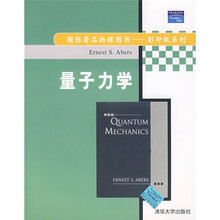
量子力学
目 录内容简介
Preface
1 Classical Mechanics
1.1 Newtons Laws, the Action, and the Hamiltonian
1.1.1 Newtons Law and Lagranges Equations
1.1.2 Hamiltons Principle
1.1.3 Canonical Momenta and the Hainiltonian Formulation .
1.2 Classical Space-Time Symmetries
1.2.1 The Space-Time Transformations
1.2.2 Translations
1.2.3 Rotations
1.2.4 Rotation Matrices
1.2.5 Symmetries and Conservation Laws
Problems
2 Fundamentals of Quantum Mechanics
2.1 The Superposition Principle
2.1.1 The Double-Slit Experiment
2.1.2 The Stern-Gerlach Experiment
2.2 The Mathematical Language of Quantum Mechanics
2.2.1 Vector Spaces
2.2.2 The Probability Interpretation
2.2.3 Linear Operators
2.2.4 Observables
2.2.5 Examples
2.3 Continuous Eigenvalues
2.3.1 The Dirac Delta Function
2.3.2 Continuous Observables
2.3.3 Fouriers Theorem and Representations of Q(x)
2.4 Canonical Commutators and the SchrSdinger Equation
2.4.1 The Correspondence Principle
2.4.2 The Canonical Commutation Relations
2.4.3 Plancks Constant
2.5 Quantum Dynamics
2.5.1 The Time-Translation Operator
2.5.2 The Heisenberg Picture
2.6 The Uncertainty Principle
2.7 Wave Functions
2.7.1 Wave Functions in Coordinate Space
2.7.2 Momentum and Translations
2.7.3 SchrSdingers Wave Equation
2.7.4 Time-Dependent Free Particle Wave Functions
Problems
3 Stationary States
3.1 Elementary Examples
3.1.1 States with Definite Energy
3.1.2 A Two-State System
3.1.3 One-Dimensional Potential Problems
3.2 The Harmonic Oscillator
3.2.1 The Spectrum
3.2.2 Matrix Elements
3.2.3 The Ground-State Energy
3.2.4 Wave Functions
3.3 Spherically Symmetric Potentials and Angular Momentum
3.3.1 Spherical Symmetry
3.3.2 Orbital Angular Momentum as a Differential Operator
3.3.3 The Angular Momentum Commutator Algebra
3.3.4 Classification of the States
3.4 Spherically Symmetric Potentials: Wave Functions
3.4.1 Spherical Coordinates and Spherical Harmonics
3.4.2 The Radial Wave Equation
3.5 Hydrogenlike Atoms
3.5.1 The Symmetries
3.5.2 The Energy Spectrum
3.5.3 The Radial Wave Functions
Problems
4 Symmetry Transformations on States
4.1 Introduction
4.1.1 Symmetries and Transformations
4.1.2 Groups of Transformations
4.1.3 Classical and Quantum Symmetries
4.2 The Rotation Group and Algebra
4.2.1 Representations of Groups
4.2.2 Representations of the Generators of Rotations
4.2.3 Generators in an Arbitrary Direction
4.2.4 Commutators of the Generators
4.2.5 Explicit Form of the Finite Dimensional Representations
4.2.6 Summary
4.3 Spin and Rotations in Quantum Mechanics
4.3.1 Rotations and Spinless Particles
4.3.2 Spin
4.3.3 The Spin-Zero Representation
4.3.4 The Spin-Half Representation
4.3.5 Euler Angles
4.3.6 The Spin-One Representation
4.3.7 Arbitrary j
4.4 Addition of Angular Momenta
4.4.1 Spin and Orbital Angular Momentum
4.4.2 Two Simple Examples
……
5 Symmetry Transformations on operators
6 Interlude
7 Approximation methods for bound states
8 Potential scattering
9 Transitions
10 Further topics in quantum dynamics
11 The quantized electromagnetic field
12 Relativistic wave equations
13 Identical particles
APPENDICES
A Mathematical tools
B Rotation Matrices
C SU(3)
D Reference
Index
1 Classical Mechanics
1.1 Newtons Laws, the Action, and the Hamiltonian
1.1.1 Newtons Law and Lagranges Equations
1.1.2 Hamiltons Principle
1.1.3 Canonical Momenta and the Hainiltonian Formulation .
1.2 Classical Space-Time Symmetries
1.2.1 The Space-Time Transformations
1.2.2 Translations
1.2.3 Rotations
1.2.4 Rotation Matrices
1.2.5 Symmetries and Conservation Laws
Problems
2 Fundamentals of Quantum Mechanics
2.1 The Superposition Principle
2.1.1 The Double-Slit Experiment
2.1.2 The Stern-Gerlach Experiment
2.2 The Mathematical Language of Quantum Mechanics
2.2.1 Vector Spaces
2.2.2 The Probability Interpretation
2.2.3 Linear Operators
2.2.4 Observables
2.2.5 Examples
2.3 Continuous Eigenvalues
2.3.1 The Dirac Delta Function
2.3.2 Continuous Observables
2.3.3 Fouriers Theorem and Representations of Q(x)
2.4 Canonical Commutators and the SchrSdinger Equation
2.4.1 The Correspondence Principle
2.4.2 The Canonical Commutation Relations
2.4.3 Plancks Constant
2.5 Quantum Dynamics
2.5.1 The Time-Translation Operator
2.5.2 The Heisenberg Picture
2.6 The Uncertainty Principle
2.7 Wave Functions
2.7.1 Wave Functions in Coordinate Space
2.7.2 Momentum and Translations
2.7.3 SchrSdingers Wave Equation
2.7.4 Time-Dependent Free Particle Wave Functions
Problems
3 Stationary States
3.1 Elementary Examples
3.1.1 States with Definite Energy
3.1.2 A Two-State System
3.1.3 One-Dimensional Potential Problems
3.2 The Harmonic Oscillator
3.2.1 The Spectrum
3.2.2 Matrix Elements
3.2.3 The Ground-State Energy
3.2.4 Wave Functions
3.3 Spherically Symmetric Potentials and Angular Momentum
3.3.1 Spherical Symmetry
3.3.2 Orbital Angular Momentum as a Differential Operator
3.3.3 The Angular Momentum Commutator Algebra
3.3.4 Classification of the States
3.4 Spherically Symmetric Potentials: Wave Functions
3.4.1 Spherical Coordinates and Spherical Harmonics
3.4.2 The Radial Wave Equation
3.5 Hydrogenlike Atoms
3.5.1 The Symmetries
3.5.2 The Energy Spectrum
3.5.3 The Radial Wave Functions
Problems
4 Symmetry Transformations on States
4.1 Introduction
4.1.1 Symmetries and Transformations
4.1.2 Groups of Transformations
4.1.3 Classical and Quantum Symmetries
4.2 The Rotation Group and Algebra
4.2.1 Representations of Groups
4.2.2 Representations of the Generators of Rotations
4.2.3 Generators in an Arbitrary Direction
4.2.4 Commutators of the Generators
4.2.5 Explicit Form of the Finite Dimensional Representations
4.2.6 Summary
4.3 Spin and Rotations in Quantum Mechanics
4.3.1 Rotations and Spinless Particles
4.3.2 Spin
4.3.3 The Spin-Zero Representation
4.3.4 The Spin-Half Representation
4.3.5 Euler Angles
4.3.6 The Spin-One Representation
4.3.7 Arbitrary j
4.4 Addition of Angular Momenta
4.4.1 Spin and Orbital Angular Momentum
4.4.2 Two Simple Examples
……
5 Symmetry Transformations on operators
6 Interlude
7 Approximation methods for bound states
8 Potential scattering
9 Transitions
10 Further topics in quantum dynamics
11 The quantized electromagnetic field
12 Relativistic wave equations
13 Identical particles
APPENDICES
A Mathematical tools
B Rotation Matrices
C SU(3)
D Reference
Index
目 录内容简介
《量子力学》具有起点较高,内容丰富,分析深刻等特点。强调对称性在量子力学中的重要性,特别是仔细分析了转动对称性与一般角动量的深刻联系;详细讨论了作为前沿科学研究基础的路径积分和电磁场量子化等。书中数学推导比较详细,便于读者自己验证推算量子力学基本内容。
比价列表


公众号、微信群
 缺书网
缺书网微信公众号
 扫码进群
扫码进群实时获取购书优惠