

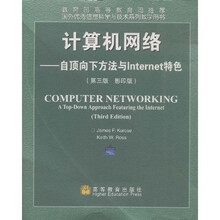
国外优秀信息科学与技术系列教学用书:自顶向下方法与Internet特色(计算机网络)(第3版影印版)
Chapter 1 Computer Networks and the Internet
1.1 What Is the Internet?
1.1.1 A Nuts-and-Bolts Description
1.1.2 A Service Description
1.1.3 What Is a Protocol?
1.2 The Network Edge
1.2.1 End Systems, Clients, and Servers
1.2.2 Connectionless and Connection-Oriented Service
1.3 The Network Core
1.3.1 Circuit Switching and Packet Switching
1.3.2 Packet-Switched Networks: Datagram Networks and Virtual-Circuit Networks
1.4 Access Networks and Physical Media
1.4.1 Access Networks
1.4.2 Physical Media
1.5 ISPs and Internet Backbones
1.6 Delay and Loss in Packet-Switched Networks
1.6.1 Types of Delay
1.6.2 "Queuing Delay and Packet Loss
1.6.3 Delay and Routes in the Internet
1.7 Protocol Layers and Their Service Models
1.7.1 Layered Architecture
1.7.2 Layers, Messages, Segments, Datagrarns, and Frames
1.8 History of Computer Networking and the Internet
1.8.1 The Development of Packet Switching: 1961-1972
1.8.2 Proprietary Networks and Internetworking: 1972-1980
1.8.3 A Proliferation of Networks: 1980-1990
1.8.4 The Internet Explosion: The 1990s
1.8.5 Recent Developments
1.9 Summary
Road-Mapping This Book
Homework Problems and Questions
Problems
Discussion Questions
Ethereal Lab 1
Interview: Leonard Kleinrock
Chapter 2 Application Layer
2.1 Principles of Network Applications
2.1.1 Network Application Architectures
2.1.2 Processes Communicating
2.1.3 Application-Layer Protocols
2.1.4 What Services Does an Application Need?
2.1.5 Services Provided by the Internet Transport Protocols
2.1.6 Network Applications Covered in This Book
2.2 The Web and HTTP
2.2.1 Overview of HTTP
2.2.2 Nonpersistent and Persistent Connections
2.2.3 HTTP Message Format
2.2.4 User-Server Interaction: Cookies
2.2.5 HTTP Content
2.2.6 Web Caching
2.2.7 The Conditional GET
2.3 File Transfer: FTP
2.3.1 FTP Commands and Replies
2.4 Electronic Mail in the Internet
2.4.1 SMTP
2.4.2 Comparison with
2.4.3 Mail Message Formats and MIME
2.4.4 Mail Access Protocols
2.5 DNS——The Internets Directory Service
2.5.1 Services Provided by DNS
2.5.2 Overview of How DNS Works
2.5.3 DNS Records and Messages
2.6 P2P File Sharing
2.7 Socket Programming with TCP
2.7.1 Socket Programming with TCP
2.8 Socket Programming with UDP
2.9 Building a Simple Web Server
2.9.1 Web Server Functions
2.10 Summary
Homework Problems and Questions
Problems
Discussion Questions
Socket Programming Assignments
Ethereal Labs
Interview: Tim Berners-Lee
Chapter 3 Transport Layer
3.1 Introduction and Transport-Layer Services
3.1.1 Relationship Between Transport and Network Layers
3.1.2 Overview of the Transport Layer in the Internet
3.2 Multiplexing and Demultiplexing
3.3 Connectionless Transport: UDP
3.3.1 UDP Segment Structure
3.3.2 UDP Checksum
3.4 Principles of Reliable Data Transfer
3.4.1 Building a Reliable Data Transfer Protocol
3.4.2 Pipelined Reliable Data Transfer Protocols
3.4.3 Go-Back-N (GBN)
3.4.4 Selective Repeat (SR)
3.5 Connection-Oriented Transport: TCP
3.5.1 The TCP Connection
3.5.2 TCP Segment Structure
3.5.3 Round-Trip Time Estimation and Timeout
3.5.4 Reliable Data Transfer
3.5.5 Flow Control
3.5.6 TCP Connection Management
3.6 Principles of Congestion Control
3.6.1 The Causes and the Costs of Congestion
3.6.2 Approaches to Congestion Control
3.6.3 Network-Assisted Congestion-Control Example:
ATM ABR Congestion Control
3.7 TCP Congestion Control
3.7.1 Fairness
3.7.2 TCP Delay Modeling
3.8 Summary
Homework Problems and Questions
Problems
Discussion Questions,
Programming Assignments
Ethereal Lab: Exploring TCP
Interview: Sally Floyd
Chapter 4 The Network Layer
4.1 Introduction
4.1.1 Forwarding and Routing
4.1.2 Network Service Models
4.2 Virtual Circuit and Datagram Networks
4.2.1 Vtrtual-Circuit Networks
4.2.2 Datagram Networks
4.2.3 Origins of VC and Datagram Networks~
4.3 Whats Inside a Router?
4.3.1 Input Ports
4.3.2 Switching Fabric
4.3.3 Output Ports
4.3.4 Where Does Queuing Occur?
4.4 The Internet Protocol (IP): Forwarding and Addressing in the Internet
4.4.1 Datagram Format
4.4.2 lPv4 Addressing
4.4.3 Internet Control Message Protocol (ICMP)
4.4.4 IPv6
4.5 Routing Algorithms
4.5.1 The Link-State (LS) Routing Algorithm
4.5.2 The Distance-Vector (DV) Routing Algorithm
4.5.3 Hierarchical Routing
4.6 Routing in the Internet
4.6.1 Intra-AS Routing in the Internet: RIP
4.6.2 Intra-AS Routing in the Internet: OSPF
4.6.3 Inter-Autonomous System Routing: BGP
4.7 Broadcast and Multicast Routing
4.7.1 Broadcast Routing Algorithms
4.7.2 Multicast
4.8 Summary
Homework Problems and Questions
Problems
Discussion Questions
Programming Assignment
Ethereal Lab
Interview: Vinton G. Cerf
Chapter 5 The Link Layer and Local Area Networks
5.1 Link Layer: Introduction and Services
5.1.1 The Services Provided by the Linl(Layer
5.1.2 Adapters Communicating
……
Chapter 6 Wireless and Mobile Networks
Chapter 7 Multimedia Networking
Chapter 8 Security in Computer Networks
Chapter 9 Network Management
References
Index
1.1 What Is the Internet?
1.1.1 A Nuts-and-Bolts Description
1.1.2 A Service Description
1.1.3 What Is a Protocol?
1.2 The Network Edge
1.2.1 End Systems, Clients, and Servers
1.2.2 Connectionless and Connection-Oriented Service
1.3 The Network Core
1.3.1 Circuit Switching and Packet Switching
1.3.2 Packet-Switched Networks: Datagram Networks and Virtual-Circuit Networks
1.4 Access Networks and Physical Media
1.4.1 Access Networks
1.4.2 Physical Media
1.5 ISPs and Internet Backbones
1.6 Delay and Loss in Packet-Switched Networks
1.6.1 Types of Delay
1.6.2 "Queuing Delay and Packet Loss
1.6.3 Delay and Routes in the Internet
1.7 Protocol Layers and Their Service Models
1.7.1 Layered Architecture
1.7.2 Layers, Messages, Segments, Datagrarns, and Frames
1.8 History of Computer Networking and the Internet
1.8.1 The Development of Packet Switching: 1961-1972
1.8.2 Proprietary Networks and Internetworking: 1972-1980
1.8.3 A Proliferation of Networks: 1980-1990
1.8.4 The Internet Explosion: The 1990s
1.8.5 Recent Developments
1.9 Summary
Road-Mapping This Book
Homework Problems and Questions
Problems
Discussion Questions
Ethereal Lab 1
Interview: Leonard Kleinrock
Chapter 2 Application Layer
2.1 Principles of Network Applications
2.1.1 Network Application Architectures
2.1.2 Processes Communicating
2.1.3 Application-Layer Protocols
2.1.4 What Services Does an Application Need?
2.1.5 Services Provided by the Internet Transport Protocols
2.1.6 Network Applications Covered in This Book
2.2 The Web and HTTP
2.2.1 Overview of HTTP
2.2.2 Nonpersistent and Persistent Connections
2.2.3 HTTP Message Format
2.2.4 User-Server Interaction: Cookies
2.2.5 HTTP Content
2.2.6 Web Caching
2.2.7 The Conditional GET
2.3 File Transfer: FTP
2.3.1 FTP Commands and Replies
2.4 Electronic Mail in the Internet
2.4.1 SMTP
2.4.2 Comparison with
2.4.3 Mail Message Formats and MIME
2.4.4 Mail Access Protocols
2.5 DNS——The Internets Directory Service
2.5.1 Services Provided by DNS
2.5.2 Overview of How DNS Works
2.5.3 DNS Records and Messages
2.6 P2P File Sharing
2.7 Socket Programming with TCP
2.7.1 Socket Programming with TCP
2.8 Socket Programming with UDP
2.9 Building a Simple Web Server
2.9.1 Web Server Functions
2.10 Summary
Homework Problems and Questions
Problems
Discussion Questions
Socket Programming Assignments
Ethereal Labs
Interview: Tim Berners-Lee
Chapter 3 Transport Layer
3.1 Introduction and Transport-Layer Services
3.1.1 Relationship Between Transport and Network Layers
3.1.2 Overview of the Transport Layer in the Internet
3.2 Multiplexing and Demultiplexing
3.3 Connectionless Transport: UDP
3.3.1 UDP Segment Structure
3.3.2 UDP Checksum
3.4 Principles of Reliable Data Transfer
3.4.1 Building a Reliable Data Transfer Protocol
3.4.2 Pipelined Reliable Data Transfer Protocols
3.4.3 Go-Back-N (GBN)
3.4.4 Selective Repeat (SR)
3.5 Connection-Oriented Transport: TCP
3.5.1 The TCP Connection
3.5.2 TCP Segment Structure
3.5.3 Round-Trip Time Estimation and Timeout
3.5.4 Reliable Data Transfer
3.5.5 Flow Control
3.5.6 TCP Connection Management
3.6 Principles of Congestion Control
3.6.1 The Causes and the Costs of Congestion
3.6.2 Approaches to Congestion Control
3.6.3 Network-Assisted Congestion-Control Example:
ATM ABR Congestion Control
3.7 TCP Congestion Control
3.7.1 Fairness
3.7.2 TCP Delay Modeling
3.8 Summary
Homework Problems and Questions
Problems
Discussion Questions,
Programming Assignments
Ethereal Lab: Exploring TCP
Interview: Sally Floyd
Chapter 4 The Network Layer
4.1 Introduction
4.1.1 Forwarding and Routing
4.1.2 Network Service Models
4.2 Virtual Circuit and Datagram Networks
4.2.1 Vtrtual-Circuit Networks
4.2.2 Datagram Networks
4.2.3 Origins of VC and Datagram Networks~
4.3 Whats Inside a Router?
4.3.1 Input Ports
4.3.2 Switching Fabric
4.3.3 Output Ports
4.3.4 Where Does Queuing Occur?
4.4 The Internet Protocol (IP): Forwarding and Addressing in the Internet
4.4.1 Datagram Format
4.4.2 lPv4 Addressing
4.4.3 Internet Control Message Protocol (ICMP)
4.4.4 IPv6
4.5 Routing Algorithms
4.5.1 The Link-State (LS) Routing Algorithm
4.5.2 The Distance-Vector (DV) Routing Algorithm
4.5.3 Hierarchical Routing
4.6 Routing in the Internet
4.6.1 Intra-AS Routing in the Internet: RIP
4.6.2 Intra-AS Routing in the Internet: OSPF
4.6.3 Inter-Autonomous System Routing: BGP
4.7 Broadcast and Multicast Routing
4.7.1 Broadcast Routing Algorithms
4.7.2 Multicast
4.8 Summary
Homework Problems and Questions
Problems
Discussion Questions
Programming Assignment
Ethereal Lab
Interview: Vinton G. Cerf
Chapter 5 The Link Layer and Local Area Networks
5.1 Link Layer: Introduction and Services
5.1.1 The Services Provided by the Linl(Layer
5.1.2 Adapters Communicating
……
Chapter 6 Wireless and Mobile Networks
Chapter 7 Multimedia Networking
Chapter 8 Security in Computer Networks
Chapter 9 Network Management
References
Index
Jim Kuroseis a professor of Computer Science at the University of Massachusetts, Amherst.
Dr. Kurose has received a number of recognitions for his educational activities including Outstanding Teacher Awards from the National Technological University (eight times), the University of Massachusetts, and the Northeast Association of Graduate Schools. He received the IEEE Taylor Booth Education Medal and was recognized for his leadership of Massachusetts Commonwealth Information Technology Initiative. He has been the recipient of a GE Fellowship, an IBM Faculty Development Award, and a lilly Teaching Fellowship.
Dr. Kurose is a former Editor-in-Chief of the IEEE Transactions on Communications and of the IEEE/ACM Transactions on Networking. He has been active in the program committees for IEEE Infocom, ACM SIGCOMM, and ACM SIGMETRICS for a number of years and has served as Technical Program Co-Chair for those conferences. He is a Fellow of the IEEE and the ACM. His research interests include netork protocols and architecture, network measurement, sensor networks, multimedia communication, and modeling and performance evaluation. He holds a Ph.D.in Computer Science from Columbia University.
Keith Ross is the Leornard J. Shustek Professor in Computer Science at Polytechnic University in Brooklyn. From 1985 to 1998 he was a professor in the Department of Systems Engineering at the University of Pennsylvania. From 1998 to 2003 he was a professor in the Multimedia Communications Department at Institute Eurecom in France. Keith Ross is also the principal founder and original CEO of Wimba, which develops voice-over-IP technologies for e-learning markets.
Dr. Ross has published numerous research papers and has written two books. He has served on editorial boards on many major journals, including IEEE/ACM Transactions on Networking, and on numerous programming committees, including ACM SIGCOMM and IEEE Infocom. He has supervised 15 Ph.D. theses. His research and teaching interests include P2P systems, multimedia netvvorking, network protocols, and stochastic networks. He received his Ph.D. from the University of Michigan.
Dr. Kurose has received a number of recognitions for his educational activities including Outstanding Teacher Awards from the National Technological University (eight times), the University of Massachusetts, and the Northeast Association of Graduate Schools. He received the IEEE Taylor Booth Education Medal and was recognized for his leadership of Massachusetts Commonwealth Information Technology Initiative. He has been the recipient of a GE Fellowship, an IBM Faculty Development Award, and a lilly Teaching Fellowship.
Dr. Kurose is a former Editor-in-Chief of the IEEE Transactions on Communications and of the IEEE/ACM Transactions on Networking. He has been active in the program committees for IEEE Infocom, ACM SIGCOMM, and ACM SIGMETRICS for a number of years and has served as Technical Program Co-Chair for those conferences. He is a Fellow of the IEEE and the ACM. His research interests include netork protocols and architecture, network measurement, sensor networks, multimedia communication, and modeling and performance evaluation. He holds a Ph.D.in Computer Science from Columbia University.
Keith Ross is the Leornard J. Shustek Professor in Computer Science at Polytechnic University in Brooklyn. From 1985 to 1998 he was a professor in the Department of Systems Engineering at the University of Pennsylvania. From 1998 to 2003 he was a professor in the Multimedia Communications Department at Institute Eurecom in France. Keith Ross is also the principal founder and original CEO of Wimba, which develops voice-over-IP technologies for e-learning markets.
Dr. Ross has published numerous research papers and has written two books. He has served on editorial boards on many major journals, including IEEE/ACM Transactions on Networking, and on numerous programming committees, including ACM SIGCOMM and IEEE Infocom. He has supervised 15 Ph.D. theses. His research and teaching interests include P2P systems, multimedia netvvorking, network protocols, and stochastic networks. He received his Ph.D. from the University of Michigan.
《计算机网络:自顶向下方法与Internet特色(第3版影印版)》讲述了:教育部要求由高等教育出版社首先开展信息科学和技术教材的引进试点工作。同时提出了两点要求,一是要高水平,二是要低价格。在高等教育出版社和信息科学技术引进教材专家组的努力下,经过比较短的时间,第一批引进的20多种教材已经陆续出版。这套教材出版后受到了广泛的好评,其中有不少是世界信息科学技术领域著名专家、教授的经典之作和反映信息科学技术最新进展的优秀作品,代表了目前世界信息科学技术教育的一流水平,而且价格也是最优惠的,与国内同类自编教材相当。这项教材引进工作是在教育部高等教育司和高教社的共同组织下,由国内信息科学技术领域的专家、教授广泛参与,在对大量国外教材进行多次遴选的基础上,参考了国内和国外著名大学相关专业的课程设置进行系统引进的。其中,John Wiley公司出版的贝尔实验室信息科学研究中心副总裁Silberschatz教授的经典著作《操作系统概念》,是我们经过反复谈判,做了很多努力才得以引进。William Stallings先生曾编写了在美国深受欢迎的信息科学技术系列教材,其中有多种教材获得过美国教材和学术著作者协会颁发的计算机科学与工程教材奖,这批引进教材中就有他的两本著作。希望《计算机网络:自顶向下方法与Internet特色(第3版影印版)》通过这些举措,能在较短的时间,为我国培养一大批高质量的信息技术人才,提高我国软件人才的国际竞争力,促进我国信息产业的快速发展,加快推动国家信息化进程,进而带动整个国民经济的跨越式发展。
比价列表


公众号、微信群
 缺书网
缺书网微信公众号
 扫码进群
扫码进群实时获取购书优惠