

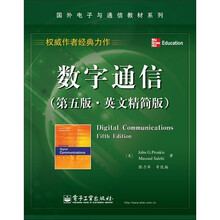
数字通信(第5版·英文精简版)
目 录内容简介
Chapter 1 Introduction
1.1 Elements of a Digital Communication System
1.2 Communication Channels and Their Characteristics
1.3 Mathematical Models for Communication Channels
1.4 A Historical Perspective in the Development of Digital ommunications
Chapter 2 Deterministic and Random Signal Analysis
2.1 Representation of Bandpass Signals and Systems
2.1-1 Representation of Bandpass Signals
2.1-2 Response of a Bandpass System to a Bandpass Signal
2.2 Signal Space Representation of Waveforms
2.2-1 Vector Space Concepts
2.2-2 Signal Space Concepts
2.2-3 Orthogonal Expansions of Signals
2.2-4 Gram-Schmidt Procedure
2.3 Some Useful Random Variables
2.4 Random Processes
2.4-1 Wide-Sense Stationary Random Processes
2.4-2 Cyclostationary Random Processes
2.5 Series Expansion of Random Processes
2.5-1 Sampling Theorem for Band-Limited RandomProcesses
2.5-2 The Karhunen-Lo`eve Expansion
2.6 Bandpass Stationary Stochastic Processes Problems
Chapter 3 Digital Modulation Schemes
3.1 Representation of Digitally Modulated Signals
3.2 Memoryless Modulation Methods
3.2-1 Pulse Amplitude Modulation (PAM)
3.2-2 Phase Modulation 3.2-3 Quadrature Amplitude Modulation
3.2-4 Multidimensional Signaling
3.3 Signaling Schemes with Memory
3.3-1 Continuous-Phase Frequency-Shift Keying(CPFSK)
3.3-2 Continuous-Phase Modulation (CPM)
3.4 Power Spectrum of Digitally Modulated Signals
3.4-1 Power Spectral Density of a Digitally Modulated Signalwith Memory
3.4-2 Power Spectral Density of LinearlyModulated Signals
3.4-3 Power Spectral Density ofDigitally Modulated Signals with Finite Memory
3.4-4Power Spectral Density of Modulation Schemes with a MarkovStructure
3.4-5 Power Spectral Densities of CPFSK and CPM Signals Problems
Chapter 4 Optimum Receivers for AWGN Channels
4.1 Waveform and Vector Channel Models
4.1-1 Optimal Detection for a General Vector Channel
4.2 Waveform and Vector AWGN Channels
4.2-1 Optimal Detection for the Vector AWGN Channel
4.2-2 Implementation of the Optimal Receiver for AWGN Channels
4.2-3 A Union Bound on the Probability of Error of Maximum Likelihood Detection
4.3 Optimal Detection and Error Probability for Band-Limited Signaling
4.3-1 Optimal Detection and Error Probability for ASK or PAM Signaling
4.3-2 Optimal Detection and Error Probability for PSK Signaling
4.3-3 Optimal Detection and Error Probability for QAM Signaling
4.3-4 Demodulation and Detection
4.4 Optimal Detection and Error Probability for Power-Limited Signaling
4.4-1 Optimal Detection and Error Probability for Orthogonal Signaling
4.4-2 Optimal Detection and Error Probability for Biorthogonal Signaling
4.4-3 Optimal Detection and Error Probability for Simplex Signaling
4.5 Optimal Detection in Presence of Uncertainty: Noncoherent Detection
4.5-1 Noncoherent Detection of Carrier Modulated Signals
4.5-2 Optimal Noncoherent Detection of FSK Modulated Signals
4.5-3 Error Probability of Orthogonal Signaling with Noncoherent Detection
4.5-4 Probability of Error for Envel
1.1 Elements of a Digital Communication System
1.2 Communication Channels and Their Characteristics
1.3 Mathematical Models for Communication Channels
1.4 A Historical Perspective in the Development of Digital ommunications
Chapter 2 Deterministic and Random Signal Analysis
2.1 Representation of Bandpass Signals and Systems
2.1-1 Representation of Bandpass Signals
2.1-2 Response of a Bandpass System to a Bandpass Signal
2.2 Signal Space Representation of Waveforms
2.2-1 Vector Space Concepts
2.2-2 Signal Space Concepts
2.2-3 Orthogonal Expansions of Signals
2.2-4 Gram-Schmidt Procedure
2.3 Some Useful Random Variables
2.4 Random Processes
2.4-1 Wide-Sense Stationary Random Processes
2.4-2 Cyclostationary Random Processes
2.5 Series Expansion of Random Processes
2.5-1 Sampling Theorem for Band-Limited RandomProcesses
2.5-2 The Karhunen-Lo`eve Expansion
2.6 Bandpass Stationary Stochastic Processes Problems
Chapter 3 Digital Modulation Schemes
3.1 Representation of Digitally Modulated Signals
3.2 Memoryless Modulation Methods
3.2-1 Pulse Amplitude Modulation (PAM)
3.2-2 Phase Modulation 3.2-3 Quadrature Amplitude Modulation
3.2-4 Multidimensional Signaling
3.3 Signaling Schemes with Memory
3.3-1 Continuous-Phase Frequency-Shift Keying(CPFSK)
3.3-2 Continuous-Phase Modulation (CPM)
3.4 Power Spectrum of Digitally Modulated Signals
3.4-1 Power Spectral Density of a Digitally Modulated Signalwith Memory
3.4-2 Power Spectral Density of LinearlyModulated Signals
3.4-3 Power Spectral Density ofDigitally Modulated Signals with Finite Memory
3.4-4Power Spectral Density of Modulation Schemes with a MarkovStructure
3.4-5 Power Spectral Densities of CPFSK and CPM Signals Problems
Chapter 4 Optimum Receivers for AWGN Channels
4.1 Waveform and Vector Channel Models
4.1-1 Optimal Detection for a General Vector Channel
4.2 Waveform and Vector AWGN Channels
4.2-1 Optimal Detection for the Vector AWGN Channel
4.2-2 Implementation of the Optimal Receiver for AWGN Channels
4.2-3 A Union Bound on the Probability of Error of Maximum Likelihood Detection
4.3 Optimal Detection and Error Probability for Band-Limited Signaling
4.3-1 Optimal Detection and Error Probability for ASK or PAM Signaling
4.3-2 Optimal Detection and Error Probability for PSK Signaling
4.3-3 Optimal Detection and Error Probability for QAM Signaling
4.3-4 Demodulation and Detection
4.4 Optimal Detection and Error Probability for Power-Limited Signaling
4.4-1 Optimal Detection and Error Probability for Orthogonal Signaling
4.4-2 Optimal Detection and Error Probability for Biorthogonal Signaling
4.4-3 Optimal Detection and Error Probability for Simplex Signaling
4.5 Optimal Detection in Presence of Uncertainty: Noncoherent Detection
4.5-1 Noncoherent Detection of Carrier Modulated Signals
4.5-2 Optimal Noncoherent Detection of FSK Modulated Signals
4.5-3 Error Probability of Orthogonal Signaling with Noncoherent Detection
4.5-4 Probability of Error for Envel
目 录内容简介
《数字通信(第5版·英文精简版)》是在《数字通信(第5版)》的基础上,根据国内的实际教学情况进行精简和改编的。主要的精简原则为:保留信号传输理论内容,舍去信息传输理论内容,并以传统而经典的数字传输理论为主,无线通信为辅。改编的部分主要是根据国内实际教学的常用习惯来进行的。精简后的内容主要涵盖:确定与随机信号分析;数字调制方法;AWGN信道的最佳接收机;载波和符号同步;通过带限信道的数字通信;自适应均衡;多信道和多载波系统;数字通信用扩频信号;衰落信道:信道特征与信号传输;多天线系统。
比价列表


公众号、微信群
 缺书网
缺书网微信公众号
 扫码进群
扫码进群实时获取购书优惠